

Overview
That SEO trick boosting your rankings today could get your website buried tomorrow. As a digital marketing company that helps small businesses grow the right way, we’re breaking down how Google’s spam updates work, which shortcuts get caught, and how to build rankings that last.
Highlights
- • What Is a Google Spam Update?
- • Google Isn’t Slowing Down: The 2026 Spam Update Timeline
- • Why SEO Hacks Work... Until They Don’t
- • Common SEO Shortcuts That Can Turn Into Spam
Introduction
Picture this: you run a busy plumbing company. Your friend who runs a contracting business swears they know a trick that got their business onto page one of Google in under a week. No long-term strategy, no months of waiting, just a clever little workaround. You try it, and sure enough, it works. The phone starts ringing, new leads pour in, and you’re feeling pretty smart about the whole thing.
Then one morning, the phone goes quiet. You search for your business and can’t find it anywhere. Your traffic didn’t dip. It fell off a cliff.
What happened? Google caught up.
Google isn’t sitting back and letting businesses game its search results. It’s actively hunting for the tactics people use to cut the line, and it rolls out a Google spam update several times a year to close the loopholes. That clever trick that slipped through the cracks today? It’s exactly the kind of thing the next update is built to catch.
In this post, we’ll explain what Google spam updates are (in plain English, we promise), walk through the common shortcuts that can land your site in hot water, and explain why following Google’s rules is still the smartest, safest way to grow your business online.
What Is a Google Spam Update?

A Google spam update is a significant improvement to the automated systems Google uses to detect search spam. Those systems run around the clock, and when Google makes a notable upgrade to how they work, it announces it as a spam update.
In other words, Google’s spam filter never takes a day off. A spam update is the moment it gets sharper.
Meet SpamBrain, Google’s Spam-Fighting Robot
Behind the scenes, Google relies on a system called SpamBrain. It’s an AI-based spam-prevention system that Google improves from time to time so it gets better at spotting spam and can catch new types as they appear.
Think of SpamBrain as a security guard who studies every new trick in the book. The more people try to sneak past, the better it gets at recognizing them.
So What Does Google Consider Spam?
Google’s definition is broader than most business owners expect. Google defines spam as techniques used to deceive users or manipulate its systems into featuring content prominently, and that explicitly includes attempts to manipulate generative AI responses in Google Search.
That last part is worth pausing on. If you’ve gotten an email or a cold call promising “secret hacks” to get your business mentioned in Google’s AI Overviews, Google has already put those tactics on its radar. The new frontier of search comes with the same old rules.
Spam Updates vs. Core Updates: What’s the Difference?
Google rolls out two kinds of updates that often get mixed up, and the difference matters.
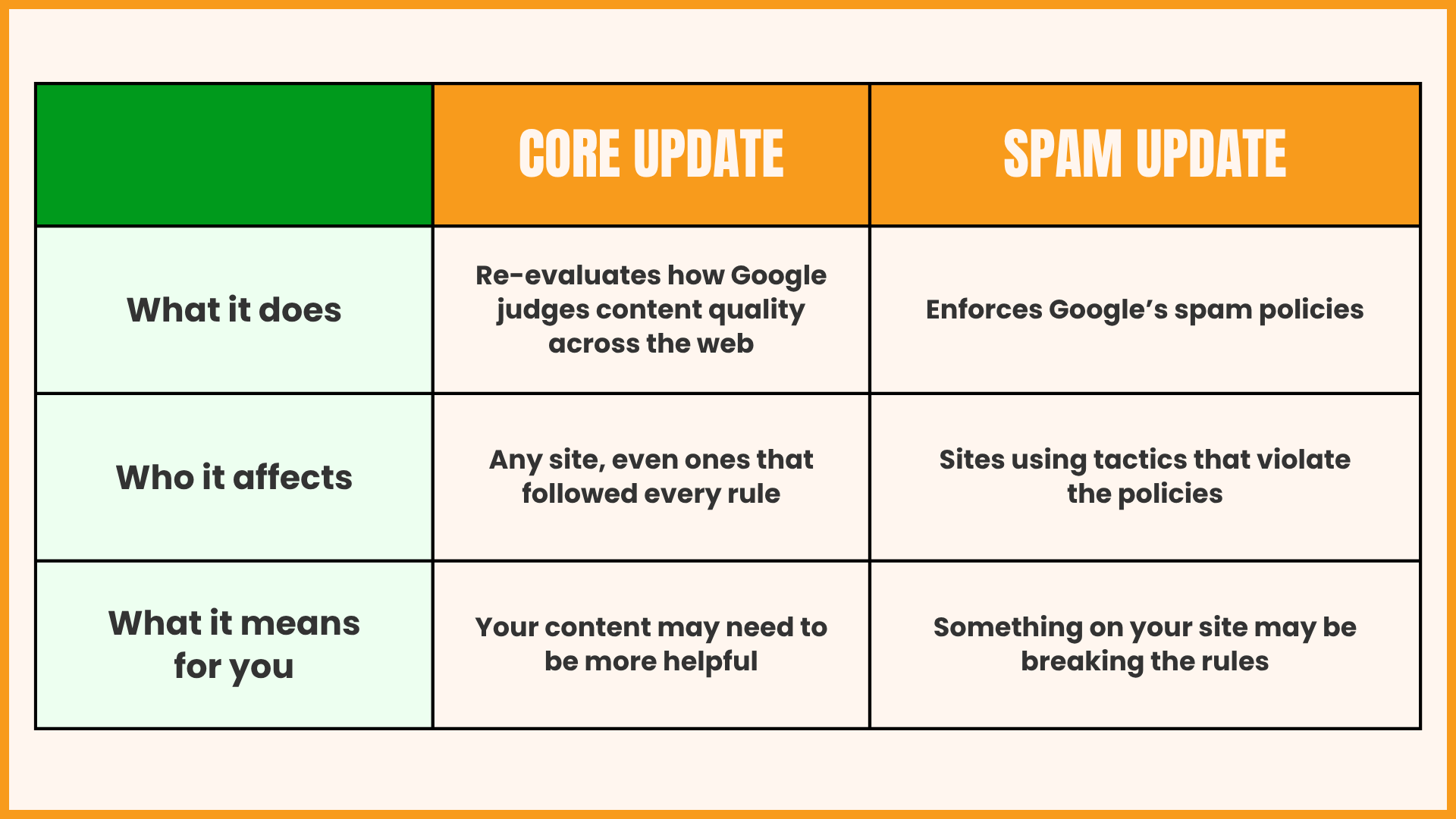
A core update can move rankings for sites that haven’t broken any policies, while a spam update is an enforcement action aimed specifically at sites that violate Google’s spam policies.
Put simply, a core update is Google raising the bar for everyone. A spam update is Google writing tickets.
The Key Takeaway: These Changes Stick
Here’s the part that catches many business owners off guard. A spam update isn’t a temporary filter Google flips on for a few days. The changes it makes to Google’s systems keep operating after the rollout is marked complete.
So if a shortcut gets caught in a spam update, waiting it out won’t help. The guard doesn’t go home when the update ends. They just got better at their job.
Google Isn’t Slowing Down: The 2026 Spam Update Timeline
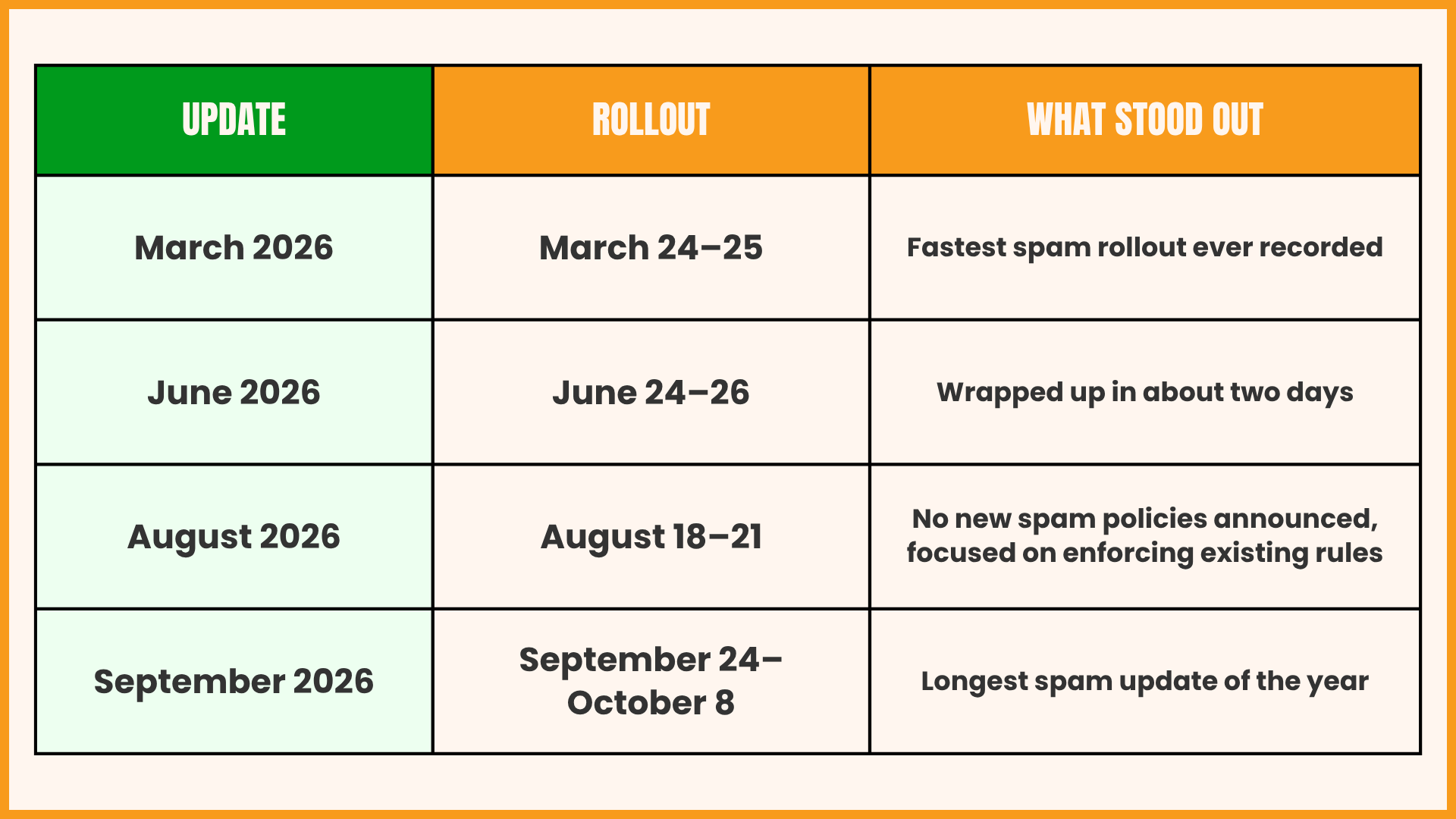
If you’re hoping Google will eventually get tired of chasing spam, we have some bad news. 2026 has been one of the busiest years for spam enforcement in recent memory. The September rollout was the fourth spam update of the year, making 2026 the most active year for Google spam updates in the last five years.
Here’s how the year has played out so far.
What This Means for Your Business
Do the math: that’s four spam updates in roughly six months. And spam updates aren’t the only changes Google is making. Google began rolling out the November 2026 core update on November 10, and it’s the eighth ranking update listed on Google’s Search Status Dashboard so far this year.
So if a shortcut slips past one spam update, don’t celebrate just yet. With updates arriving every few months, any tactic that breaks the rules is living on borrowed time.
The question isn’t if Google catches up. It’s when.
Why SEO Hacks Work... Until They Don’t
Here’s the frustrating truth: a lot of SEO shortcuts do work. At least for a little while. That’s exactly what makes them so tempting, and so dangerous.
To understand why, it helps to know how the game typically plays out.
The Cat-and-Mouse Cycle
Almost every SEO “hack” follows the same life cycle:
- Someone finds a loophole: A clever marketer notices a gap in how Google ranks pages and figures out how to exploit it.
- The trick spreads: It shows up in a viral post, a webinar, or a “secret strategy” course. Suddenly thousands of websites are doing the same thing.
- Google spots the pattern: When thousands of sites start behaving the same unnatural way, it stops looking clever and starts looking like spam.
- An update closes the gap: Google tunes its systems, and every site using the trick takes the hit at once.
Notice who wins here. The person who discovered the loophole might enjoy a short boost before the crowd shows up. But by the time a hack reaches a small business owner through a Facebook ad or a friend of a friend, it’s usually already on Google’s radar. You’re not getting in early. You’re getting in right before the doors slam shut.
“It’s Not on the List” Doesn’t Mean It’s Safe
Some business owners take a more lawyerly approach: “I read Google’s spam policies, and my tactic isn’t mentioned anywhere. So I’m in the clear, right?”
Not quite. Google states that its policies cover common spam practices, but that it may act against any type of spam practice it detects.
In other words, Google’s list of spam tactics is a set of examples, not a complete rulebook. If a tactic exists mainly to trick Google rather than help your customers, it can be treated as spam whether it has a name yet or not.
Two Ways To Get Caught
Google has two ways to catch spam, and you have to get past both of them.
The first is automation. Google detects policy-violating practices through automated systems and, when needed, through human review that can result in a manual action. So even if a tactic sneaks past the algorithm, a real person at Google can still flag your site.
Either way, the consequences are the same. Sites that violate Google’s policies may rank lower in search results or not appear at all. For a local business, not appearing at all means customers searching for exactly what you sell will find your competitors instead.

Common SEO Shortcuts That Can Turn Into Spam
Most business owners who get caught by a spam update didn’t set out to cheat. They took advice from the wrong person, copied what a competitor was doing, or tried something that seemed harmless.
Here are some of the most common shortcuts that can land a small business in hot water.
Keyword Stuffing
Scroll to the bottom of enough local business websites and you’ll find it: a footer packed with every town, suburb, and neighborhood within 50 miles. “Serving Springfield, Shelbyville, Capital City, Ogdenville, North Haverbrook...” and on and on.
It’s easy to see the logic. You want to show up when someone in each of those towns searches for your services, so why not mention them all? The problem is that Google sees right through it. Its spam policies specifically name blocks of text listing the cities and regions a page is trying to rank for, along with lists of phone numbers that don’t add real value, as examples of keyword stuffing.
The better approach is to mention the areas you serve where it naturally makes sense, like on your contact page or in a project description, rather than dumping them into a wall of text nobody reads.
Mass-Produced AI Content
AI writing tools have made it possible to publish 200 blog posts in a single weekend. For a busy business owner who’s been told “you need more content,” that can sound like a dream come true.
Here’s the catch. Google defines scaled content abuse as generating many pages mainly to manipulate search rankings rather than to help users, and one of its listed examples is using generative AI tools to create many pages without adding value for users.
To be clear, using AI doesn’t automatically make your content spam. Plenty of businesses use AI to brainstorm, outline, or polish their writing. Google’s concern is unoriginal content at scale that offers little to no value, no matter how it was created. One thoughtful post that answers a real customer question will do more for you than a hundred generic ones.
Hidden Text
This is one of the oldest tricks in the book, and somehow it still pops up. The idea is to load a page with keywords that search engines can read but visitors can’t see.
Google’s examples include white text on a white background, text hidden behind an image, text pushed off-screen with CSS, and setting the font size or opacity to zero. If you’ve inherited an older website, it’s worth checking that a past developer didn’t leave any of this behind.
If your site uses expandable sections, don’t panic. Google says that accordions or tabs that toggle content, sliders, tooltips, and text meant only for screen readers don’t violate its policies. The line is intent: hiding content to tidy up a page is fine, while hiding it to fool Google is not.
Expired Domain Abuse
Some people buy old domain names that used to belong to established websites, hoping to inherit the previous owner’s reputation with Google. The pitch usually goes something like this: “This domain has years of authority. Put your content on it and you’ll rank in no time.”
Google has a name for this. Expired domain abuse is when an expired domain is bought and repurposed mainly to manipulate search rankings with content that offers little or no value to users. One of Google’s illustrative examples is casino content on a site that used to belong to an elementary school. Your business probably isn’t running a casino, but the principle applies to any domain bought for its history rather than its fit.
Fake or Incentivized Reviews
Technically, this one falls under Google’s review policies for Maps and Business Profiles rather than its web search spam policies. But for local businesses, it’s probably the most common shortcut of all. It might look like paying for a batch of five-star reviews, asking friends and family to post glowing feedback, or offering customers a discount in exchange for a review. Both Google and the FTC prohibit incentives tied to reviews.
Google is cracking down hard. In 2025, it blocked or removed over 292 million policy-violating reviews and eliminated more than 13 million fake business profiles on Google Maps, a 21% jump in fake review removals compared to 2024.
The consequences go beyond losing a few reviews. When Google detects a sudden spike in spam reviews on a business profile, it removes the fake content, temporarily pauses new reviews, alerts the business owner, and displays a notification banner explaining why contributions are paused. That banner is visible to every potential customer who looks you up. It’s hard to imagine a worse first impression.
The honest route is simpler: ask every happy customer for a review, make it easy for them to leave one, and respond to the reviews you get, good or bad.
Build SEO That Survives Every Update
Sustainable SEO isn’t flashy. Writing genuinely helpful content, building local pages that serve your customers, and earning honest reviews one happy client at a time won’t get you to page one by next Tuesday. But those efforts stack on top of each other. Every useful page, every real review, and every satisfied customer who finds you through search adds to a foundation that keeps growing month after month.
And when the next spam update rolls out, that foundation stays standing. While businesses that relied on shortcuts are scrambling to figure out where their traffic went, you’ll be too busy answering the phone to notice.
At LinkNow, we believe there’s no such thing as a shortcut worth risking your business over. That’s why we stick to white hat SEO practices that follow Google’s guidelines. Get in touch with our team to talk about your digital marketing goals.