
Overview
The marketing plan that keeps one business’s phone ringing can leave another wondering why nobody’s calling. Learn how to match your research, website, tone, reviews, and ad budget to the way your customers actually buy, backed by 2026 data.
Highlights
- • Why One-Size-Fits-All Marketing Fails Small Businesses
- • How Your Marketing Playbook Changes by Industry
- • Things That Stay the Same Regardless of Your Industry
Introduction
There’s no shortage of marketing advice for small businesses. Post every day. Start a blog. Run Google Ads. Get on Instagram. The trouble is, most of that advice is written as if every business sells the same thing to the same kind of customer. They don’t. And a strategy that keeps one business booked solid can leave another wondering why the phone isn’t ringing.
That’s why an industry-specific marketing strategy matters. The way people choose a café has almost nothing in common with the way they choose a dentist, a contractor, or a lawyer. Those differences shape where customers look, what convinces them, how much it costs to reach them, and what your website needs to say the moment they arrive.
In this guide, we’ll break down why generic marketing plans fall short, how each part of your marketing should adapt to your industry, and which fundamentals stay the same no matter what you sell.
Why One-Size-Fits-All Marketing Fails Small Businesses

Picture two business owners walking into the same marketing agency on the same Monday morning. One runs a busy auto repair shop in a bustling city. The other is a personal injury lawyer in a small town. They both walk out with the exact same marketing plan.
Six months later, the auto shop is doing fine. The lawyer is wondering why nobody’s calling.
The package wasn’t bad. It was just built for a business, not their business. Here’s why that matters more than most owners realize.
Customers Don’t Shop for Every Business the Same Way
The way someone picks a lunch spot has almost nothing in common with the way they pick a surgeon. Before you can decide where to spend a single marketing dollar, you need to understand how your customers make decisions. Four factors shape that process more than anything else.
Urgency
When a pipe bursts at 2 a.m., nobody is reading blog posts or comparing Instagram aesthetics. They’re tapping the first trustworthy phone number they find. Compare that to someone planning a kitchen renovation, who might spend three months browsing photos, reading reviews, and collecting quotes. Same broad industry, completely different marketing needs.
Price and Risk
Choosing the wrong coffee shop costs you five dollars and a mediocre latte. Choosing the wrong dentist for implants costs thousands of dollars and possibly your smile. The higher the stakes, the more proof customers need before they commit: credentials, detailed reviews, before-and-after photos, and clear answers to their questions.
Purchase Frequency
A barber might see the same client every three weeks for a decade. A wedding venue (hopefully) sees each couple exactly once. Businesses with repeat customers win by keeping people coming back through loyalty perks, email reminders, and easy rebooking. One-time-purchase businesses win by being found and trusted at the exact moment someone starts searching.
Emotional vs. Rational Buying
Some purchases are driven by feelings: excitement, cravings, self-expression, or relief. Others are driven by logic: price comparisons, specs, warranties, and qualifications. A bakery can sell with mouth-watering photos. An accounting firm needs to sell with clarity and confidence.
Put urgency and risk together, and a clear pattern emerges:
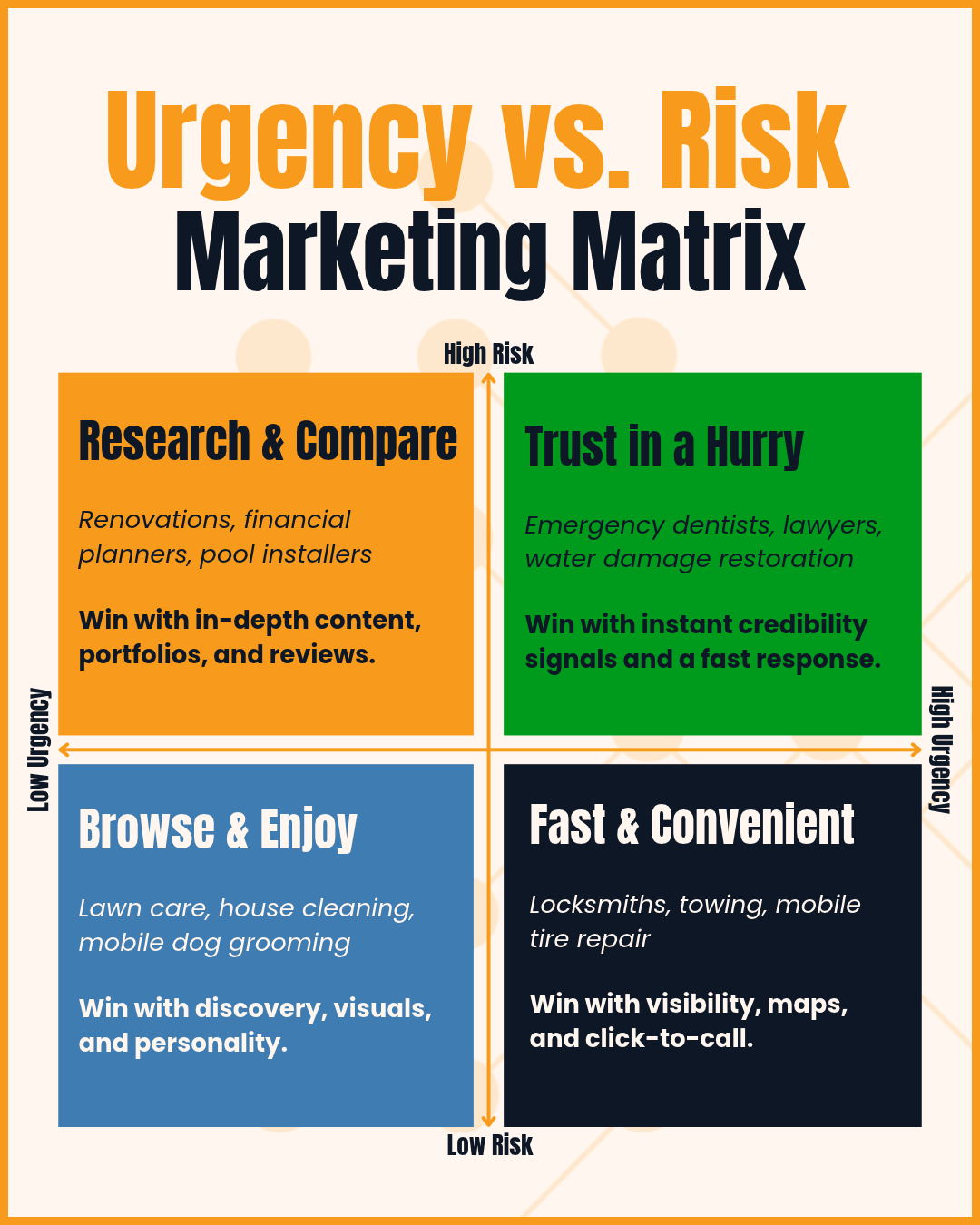
Find your business on that grid, and you’ll already have a better sense of where your marketing should focus than any generic template can give you.
The Numbers Prove It: Ad Costs Vary Wildly by Industry
If you’ve ever heard “Just put a few hundred dollars into Google Ads,” here’s why that advice needs an asterisk.
WordStream’s 2026 Google Ads Benchmarks looked at over 13,000 search advertising campaigns across 23 industries running between April 2025 and March 2026, and found that the average cost per click in Google Ads in 2026 is $5.42.
But averages hide the real story. The gap between industries is huge. Industries with the lowest CPCs included Arts and Entertainment ($1.63), Restaurants and Food ($2.05), and Travel ($2.14). Meanwhile, industries with the highest CPCs included Attorneys and Legal Services ($9.87), Home and Home Improvement ($8.33), and Dentists and Dental Services ($8.00).
And the clicks are only half of it. What really matters is what you pay to get an actual lead, like a phone call, a booking, or a form submission. The industry with the lowest cost per lead in 2026 is Arts and Entertainment at $26.84, followed by Automotive Repair at $29.96 and Restaurants and Food at $30.57. On the opposite end, Attorneys and Legal Services sit at $131.63, followed by Furniture at $106.70 and Real Estate at $102.51.
Here’s what that looks like in real life. Take that classic “$500 a month on Google Ads” rule of thumb:
- • A restaurant at about $30.57 per lead gets roughly 16 leads.
- • A law firm at about $131.63 per lead gets fewer than 4 leads.
Same budget. Same platform. Totally different results.
Before any lawyers reading this cancel their ad campaigns, though, there’s an important point to understand. An expensive click isn’t automatically a bad deal. As one benchmark analysis points out, a higher CPC is not automatically a problem if those clicks lead to qualified customers. A single new legal client might be worth thousands of dollars, while a pizza order might be worth twenty-five. The real question isn’t “How much does a lead cost?” It’s “How much is a customer worth to my business?”
How Your Marketing Playbook Changes by Industry

Remember the Urgency vs. Risk chart from the last section? This is where it becomes a working tool. Every part of your marketing, from the keywords you research to the way your website is laid out, should bend to fit where your business sits on that grid.
Below are five building blocks (plus one bonus tip) of a local marketing plan, and how to tailor each one to your industry. You don’t need to overhaul everything at once. Read through, find the gaps, and start with whatever feels most out of step with how your customers actually buy.
How Your Customers Search
Not all searches are created equal. Before you do anything else, figure out which kind of searcher you’re dealing with most often.
- • The “right now” searcher types things like “emergency plumber near me” or “24-hour locksmith.” They’re usually on a phone, often stressed, and they’ll pick from the top few results on the map. If your business sits on the high-urgency side of the matrix, this is your main customer.
- • The comparison shopper searches “best family dentist in [city]” or “top-rated wedding venues.” They’ll open several tabs, read reviews, and come back more than once, sometimes switching between phone and laptop over a few days.
- • The researcher asks questions: “How much does a kitchen renovation cost?” or “Do I need a lawyer for a small claims case?” These people are early in their decision, and the business that answers their question well often earns their trust (and their call) later.
- • The browser isn’t searching Google at all. They’re scrolling Instagram or TikTok, discovering a boutique or café because something caught their eye.
And there’s a newer entry on the list. BrightLocal’s 2026 Local Consumer Review Survey found that AI search engines have become the third most-used recommendation tool, behind Facebook and Google. That means clear, well-organized information about your business matters more than ever, because it’s what AI tools pull from when they recommend local businesses.
High-urgency businesses should obsess over map visibility and mobile. High-risk businesses should plan for long, multi-visit research journeys. Low-risk, low-urgency businesses should invest in being discoverable on social platforms.
Your Research Method
Most small business owners skip research and jump straight to posting. But what you should study first depends on your industry.
- • If you’re high urgency, start with the map. Search your main services from a phone in different parts of your service area and note who shows up in the top three. Then check your Google Business Profile’s Performance report to see which searches are already finding you.
- • If you’re high risk, start with questions. Ask your front desk or sales team to write down every question customers ask for two weeks. Then search those questions on Google and look at the “People also ask” box. That list becomes your content plan.
- • If you rely on browsers, start with what’s trending. Look at what’s getting attention in your niche on social media and use Google Trends to spot seasonal spikes, like when gift searches or patio-season searches start climbing.
- • If you depend on repeat customers, start with your own data. Your booking system, POS, or email list already tells you who comes back, how often, and when they drift away.
Website Layout Priorities
Your website has about one screen’s worth of space to convince a visitor they’re in the right place. What goes on that first screen should change with your industry.
- • High urgency: Put a click-to-call button at the top (ideally one that stays visible as visitors scroll on mobile), along with your hours, service area, and something that says “available now” if it’s true. Nobody in a panic wants to dig through a menu to find your phone number.
- • High risk: Lead with trust. Licenses, certifications, years in business, real team photos, and a few strong reviews should be visible early. Deeper pages, such as detailed service pages, bios, and FAQs, give researchers the reassurance they need to reach out.
- • Low risk, browse-driven: Let visuals do the heavy lifting. Big, high-quality photos, a clear product or services section, and an easy way to buy, order, or get in touch.
- • Repeat-purchase: Make rebooking effortless. Online booking or contact forms should be one tap away, and an email or loyalty signup gives you a way to bring people back.
Look at your homepage on your phone. If the one action your customers most need to take isn’t visible without scrolling, that’s your first fix.
Content Tone
The words on your website and social channels should sound like your industry’s customers need them to sound.
Emotional, low-risk industries can be playful, sensory, and full of personality. A little humor goes a long way, and nobody expects a bakery to sound like a bank.
Rational, high-risk industries need calm, clear, confident language. Skip the hype and exclamation points. Explain things simply, avoid jargon, and show your expertise.
There’s also an SEO reason to take tone seriously in high-stakes fields. Google says its systems give even more weight to content that aligns with strong E-E-A-T for topics that could significantly impact people’s health, financial stability, or safety. Google calls these “Your Money or Your Life” topics. If you’re a clinic, law firm, or financial professional, it helps to put real names and credentials on your content, and review anything that gives advice.
Review Strategy
Every business needs reviews, but what makes a review valuable changes by industry.

Repeat-purchase and low-risk businesses win on volume and freshness. A steady stream of new reviews shows you’re busy and consistent. Make asking for reviews part of your routine, like a QR code at the counter or a follow-up text after an appointment.
High-risk businesses win on detail. A review that says “great service!” helps a little. A review that says “They explained every step of my situation and kept me updated weekly” helps a lot. When you ask for reviews, gently encourage customers to mention the specific service they received (and, if relevant, their neighborhood, which can also help local search).
High-urgency businesses win on speed and responsiveness. People skimming reviews in a hurry notice whether you reply, and how. A calm, professional response to a negative review can be as persuasive as five positive ones.
Your Quick Win
If all of this feels like a lot, start with one move. Find your spot on the Urgency vs. Risk Matrix and pick the matching action:
- • Fast and Convenient (high urgency, low risk): Fill out every field of your Google Business Profile, double-check your hours, and add a click-to-call button that stays visible on mobile.
- • Trust in a Hurry (high urgency, high risk): Add your credentials, licenses, and three of your most detailed reviews to the top of your homepage.
- • Research and Compare (low urgency, high risk): Turn your ten most common customer questions into an FAQ or a short series of blog posts.
- • Browse and Enjoy (low urgency, low risk): Commit to posting fresh photos to your Google Business Profile and your main social channel every week for a month.
One small, well-matched change will do more for your business than a dozen generic tactics borrowed from someone else’s playbook.
Things That Stay the Same Regardless of Your Industry
After all this talk about tailoring, it’s worth saying clearly: not everything about marketing changes by industry. Some fundamentals apply whether you sell lawn care or legal advice. Think of them as the foundation of the house. Your industry decides the layout, the paint colors, and the furniture, but nobody gets to skip the foundation.
If you’re short on time or budget, these five basics will pay off for any local business:
- • A complete, accurate Google Business Profile: For most local businesses, your Google Business Profile is the first thing customers see, often before they ever visit your website. An incomplete or outdated profile makes even a great business look neglected.
- • Consistent name, address, and phone number everywhere: Your business name, address, and phone number (often called NAP) should match exactly across your website, Google, Facebook, review sites, and directories.
- • A fast, mobile-friendly website: Your site should load properly on phones, be easy to read without zooming, and make your main action (call, book, buy, or visit) simple to complete with a thumb.
- • Asking for and replying to reviews: Ask happy customers for reviews as part of your routine, and respond to reviews, both good and bad, promptly and professionally.
- • Tracking real outcomes, not just clicks: Clicks, likes, and website visits feel good, but they don’t pay the bills. What matters is how many of those people became paying customers.
Stop Borrowing Someone Else’s Marketing Playbook
At the end of the day, you need a marketing plan that matches your business. If you’d rather not figure all of this out on your own, that’s exactly what we’re here for. At LinkNow, we work with small businesses across a wide range of industries, from home service pros to clinics to professional firms and beyond.
Together, we’ll look at how your customers search, what your competitors are doing, and where your current marketing is (and isn’t) pulling its weight. Then we’ll build a plan designed around your industry and your goals, so every dollar you spend has a clear job to do.
Ready to find out if your marketing matches your industry? Contact us for a free consultation, and let’s build a strategy that fits.