
Overview
Your website’s URL is quietly shaping whether customers trust you, remember you, and even find you at all. In this post, we examine what makes up a URL and why getting it right matters far more than most small business owners realize.
Highlights
Introduction
Your website URL probably isn’t the first thing that comes to mind when you think about marketing. Compared with design, content, Google rankings, or social media presence, it can feel like little more than an address people type into a browser.
But that address is doing far more work than most business owners realize.
Before someone ever lands on your homepage, your URL can influence whether they trust your business, remember your name, click your link, or recognize your website as legitimate. Behind the scenes, its structure also gives search engines clues about your content and how your site is organized.
A strong URL won’t magically turn a struggling website into a marketing powerhouse. But a confusing, outdated, or poorly structured one can create unnecessary friction at nearly every stage of the customer journey.
So what makes a good URL? And which parts matter for marketing, SEO, trust, and discoverability? Let’s break down what’s hiding inside that little bar at the top of your browser and why your business should be paying attention to it.
Anatomy of a URL: The 3 Parts That Actually Matter
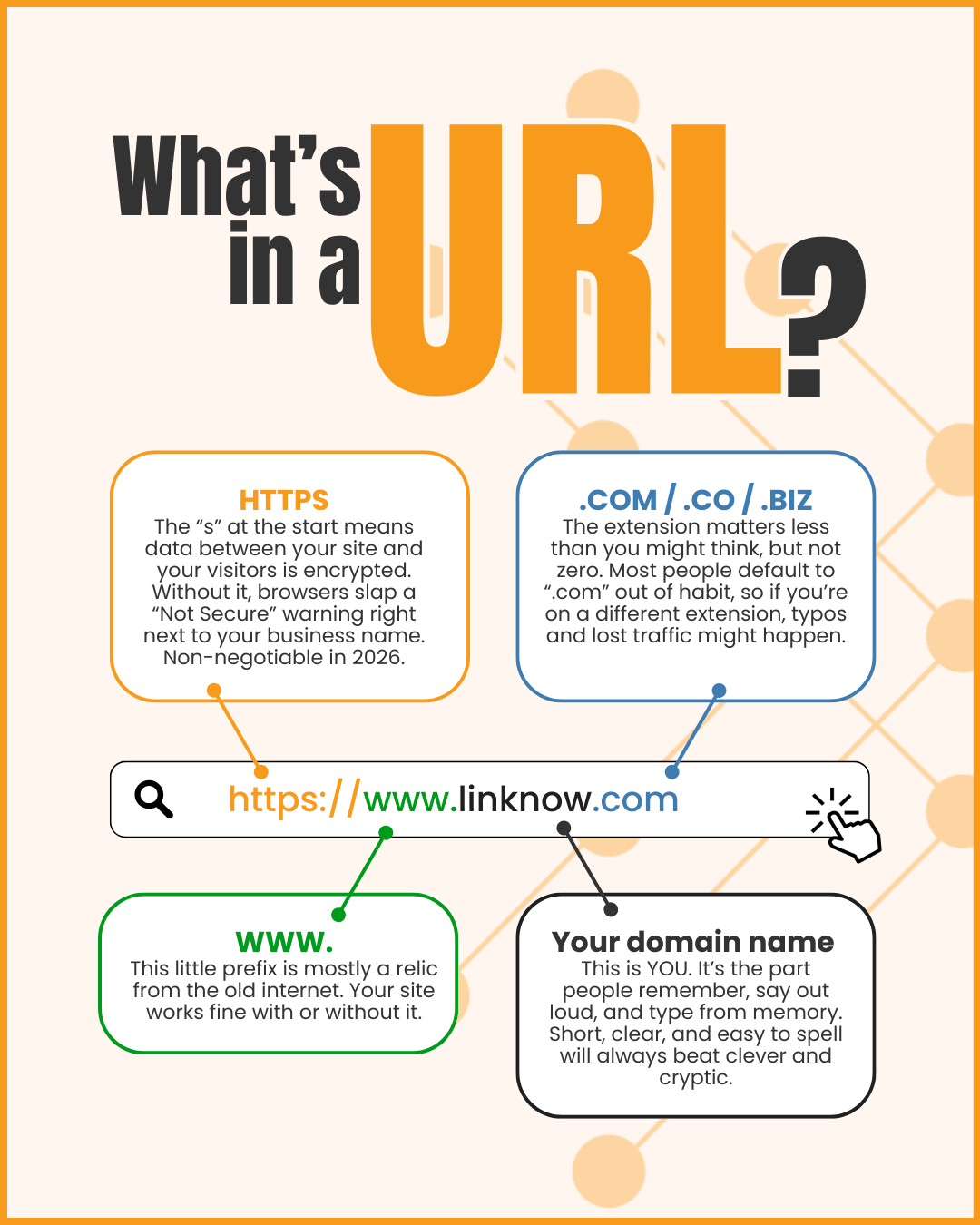
Before we get into marketing and Google rankings, let’s quickly break down what you’re really looking at when you see a URL like https://www.linknow.com. A URL is made up of three distinct parts, each doing a different job.
HTTPS (That Little Lock Icon)
In plain terms, HTTPS means your website encrypts the connection between your visitor’s browser and your server, so nobody can snoop on what’s being sent back and forth. You’ve probably noticed the little padlock icon in your address bar, and that’s HTTPS at work.
Google has used HTTPS as a ranking signal since August 2014, but that’s honestly the least important reason to care about it these days. The bigger issue is that Google has pushed for “HTTPS everywhere” for over a decade, and modern browsers have followed suit. If your site doesn’t have it, visitors get an active “Not Secure” warning before they can even see your homepage. That’s not a great first impression, and it’s an easy, often free fix through your hosting provider.
The Domain Name (Your Actual Brand)
This is the part everyone thinks of when they hear “URL.” It’s the linknow in linknow.com. This is your name on the internet, and it deserves the same care you’d put into naming your business in real life.
The best domain names are short, easy to say out loud, and easy to spell after hearing them once. Resist the urge to cram in keywords like bestresidentiallandscapersbrooklynnyc.com — it looks spammy, it’s a pain to type, and nobody’s saying that out loud or over the phone.
Your business name, kept clean and simple, will always outperform a keyword-stuffed mouthful in the ways that actually matter, like word-of-mouth, recall, and trust.
The Extension (a.k.a. the Top-Level Domain)
The extension is everything after the dot of your URL, like .com, .co, .ai, .ca, and hundreds of others. Technically, it’s called a top-level domain, and while it might seem like the least important part of your URL, it carries more weight with humans than you’d think.
For most small businesses, .com is still typically the best choice, because it’s the most recognized and trusted extension worldwide. If your ideal .com is taken, .co or .net are solid, professional-feeling alternatives.
That said, extension choice isn’t one-size-fits-all: if you’re running a business that serves a specific country or city, a country-code extension like .ca or .uk can actually build more local trust than a generic .com would, because it signals “we’re local” the moment someone sees it.
Quick myth to bust: Many business owners assume that choosing a better TLD will help them rank higher on Google. While Google has confirmed that TLDs don’t directly affect SEO, it doesn’t mean you should tune this aspect out completely. The extension still shapes whether someone trusts your link enough to click it in the first place.
In other words, top-level domains don’t move the algorithm directly, but they move the humans the algorithm is trying to please.
How Your URL Shapes Your Marketing
Your URL is actively working (or not working) for you at multiple stages of the marketing process. Here’s how.
Memorability = Free Advertising
Think about the last time you heard a business name on the radio, saw it on a delivery van, or caught it on a flyer at a coffee shop. If the URL was simple enough to remember, you might have typed it in later without a second thought. If it wasn’t, you probably just... didn’t.
That’s the quiet power of a memorable URL. It turns every physical touchpoint (your storefront sign, your business card, your invoice footer) into a piece of advertising that keeps working after the interaction ends. A short, clean, easy-to-say URL is far more likely to get typed into a browser later, which is about as close to free advertising as it gets.
Branded Email Builds Trust Instantly
If there’s one place where your URL quietly does the most marketing work, it’s your email address. The data here is hard to ignore.
The majority of consumers said they trust a company-branded email address more than a free one. That trust gap shows up again and again across market research: GoDaddy found that 75% of consumers consider a domain-based email a key factor in trusting a small business, and the effect on their purchasing behavior is significant.
Now flip that around. A different study found that only 39% of people trust a business using a free email address like Gmail or Hotmail. That’s a massive credibility gap for something that’s pretty easy to fix.
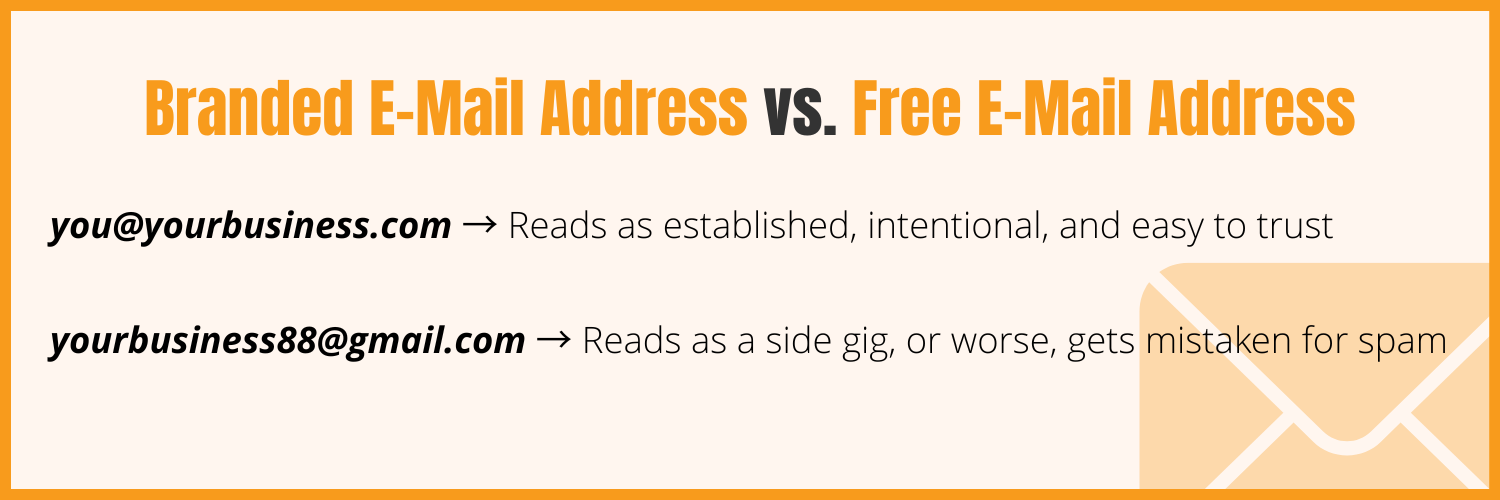
If you’re still running your business off a free email account, this is probably the single highest-ROI fix in this entire post.
Consistency Across Every Touchpoint
People don’t always click a direct link to your website; they type it, say it, and half-remember it. Your website link shows up on business cards, email signatures, social media bios, printed ads, and packaging. In many of those cases, someone is manually entering it into the address bar with no link to click at all.
That’s exactly why simplicity matters everywhere your URL appears. A clean, consistent domain means that no matter where someone encounters your business, they land in the same place and feel confident it’s really you. A messy or inconsistent URL (or worse, one that changes depending on the platform) creates just enough doubt for a potential customer to second-guess themselves and bounce. In marketing, that hesitation is often the difference between a click and a lost customer.
How Your URL Affects Discoverability
We’ve covered how your URL affects humans, but it also communicates to search engines and, increasingly, AI tools. Here’s what’s going on under the hood.
Google Emphasizes URL Structure
Google doesn’t hide much about what it wants from a URL, and its own documentation spells things out pretty clearly. We already explained how HTTPS has been confirmed by Google as a ranking signal for over a decade, but the search giant also places a lot of importance on what comes after the slash at the end of your URL.
Google recommends building URLs from simple, descriptive words, using hyphens to separate them, and avoiding unnecessary parameters or long strings of numbers and letters. In other words, Google wants your URLs to actually describe the page rather than just point to it.
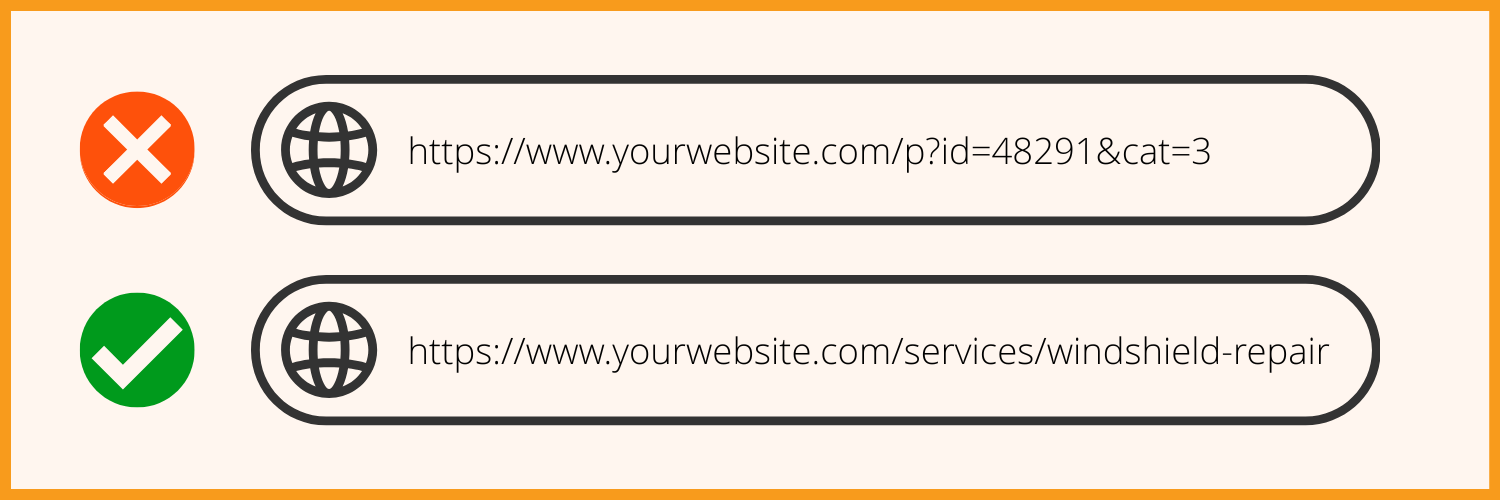
Both URLs might lead to the exact same service page, but the first one tells Google (and your visitor) exactly what’s there before the page even loads. The second one is a mystery box to both a crawler and a customer alike.
The New Wrinkle: AI Search and LLM Citations
Google isn’t the only thing checking your URL anymore. Tools like AI Overviews, Copilot, and ChatGPT Search are pulling from the web to generate answers directly, and these AI systems increasingly assess whether a source’s URL structure is organized and topically clear when deciding what to cite.
To be clear, this isn’t a hard rule with a precise formula — nobody outside these companies knows exactly how much weight URL structure carries in AI citation decisions. But the pattern lines up with common sense: a clean, descriptive URL is easier for an AI system to understand and trust at a glance, the same way it’s easier for a human.
Crawl Budget, in One Sentence
One more technical note (kept short): messy URLs with duplicate parameters, session IDs, and other unnecessary variations can cause search engines to waste time crawling near-duplicate versions of the same page, which means the important content you actually want indexed may get found and ranked more slowly than it should.
Your URL Is Working for You, Start Paying Attention to It
Your URL is already doing a job, whether you’ve thought about it or not. Every second it’s live, it’s either building trust or quietly chipping away at it. It’s either easy to remember or easily lost between your business card and someone’s search bar. It’s either helping Google and AI tools understand your business or making them work harder than they should to figure out who you even are.
The good news? Unlike a lot of marketing fixes, this one doesn’t require a rebrand, a new website, or months of work. Your business just needs a memorable domain, a branded email to match it, and a tidy URL structure. That’s it.
If you’re not sure where to start, LinkNow’s website services can help you lock in the right domain and take care of everything on the back end. It’s one of the easiest upgrades you can make to your business’s first impression, and it’s worth doing right.
Reach out to us today to start building a better online presence.