

Overview
Learn what we discovered about Google reviews after helping thousands of small businesses strengthen their online presence. This blog explores insights gained from over a decade of observing Google reviews and their effects on local SEO.
Highlights
- • Why Google Reviews Matter So Much for Small Businesses
- • Fresh Reviews Matter More Than Most Business Owners Realize
- • Review Consistency Can Protect Your Momentum
- • Customers Are More Willing To Leave Reviews Than You Think
- • Frequently Asked Questions About Google Reviews
Introduction
At LinkNow, we’ve helped more than 10,000 small businesses improve their online presence, and one thing has become clear: reviews are much more than digital compliments. They’re powerful trust signals that support local SEO and help businesses stand out in competitive markets.
That said, not all review profiles tell the same story. A business with great reviews from years ago may still look outdated if recent feedback is missing. Meanwhile, a competitor with newer reviews may feel more current, more reliable, and more relevant to today’s customers.
In this blog, we’re sharing what we’ve learned about Google reviews, why freshness and consistency matter so much, and how small businesses can turn happy customers into public proof.
Why Google Reviews Matter So Much for Small Businesses
Google reviews are often one of the first things potential customers see when they search for a local business. Before someone calls, clicks, books, or visits, they usually scan your star rating, read a few recent comments, and decide whether your business feels trustworthy.
In other words, reviews are today’s word-of-mouth—and they’re visible to everyone. A happy customer telling a neighbor is valuable. A happy customer leaving a public Google review can influence hundreds of future buyers.
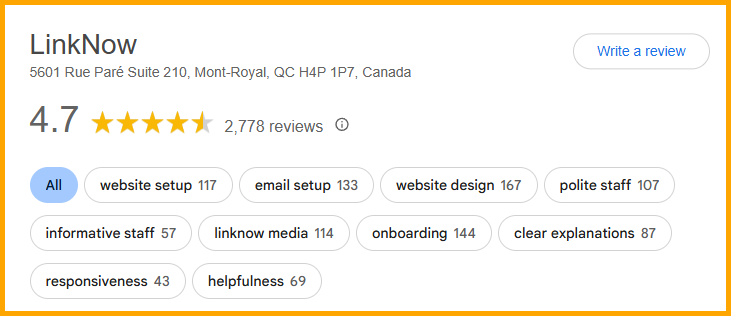
We practice what we preach at LinkNow!
Reviews can also support your local visibility on a technical level. Google says local results are based mainly on relevance, distance, and prominence, and prominence includes how well-known a business is. Google also clearly states that more reviews and positive ratings can improve local ranking.
For small businesses, that makes reviews more than nice feedback. They’re trust signals, sales tools, and local SEO assets working around the clock. This comes as no surprise to us at LinkNow, as we’ve seen firsthand how reviews can impact local businesses. Let’s take a closer look at what we learned.
Fresh Reviews Matter More Than Most Business Owners Realize
Older reviews are still valuable. A glowing five-star review from 2022 can show potential customers that your business has delivered great service before. But when someone is deciding who to call today, recent reviews usually feel more persuasive.
Think of reviews a little like the weather report. Yesterday’s forecast might give you some context, but you probably wouldn’t plan your day around it. You want the most up-to-date information possible. Customers think the same way when comparing local businesses.
A five-star review from three years ago is nice. A five-star review from last week feels reassuring.
That freshness matters because customers are not only asking, “Has this business ever done good work?” They’re asking: “Is this business still doing good work right now?”
That question becomes even more important in trust-heavy industries. Homeowners hiring a roofer, parents choosing a daycare, patients looking for a dentist, or business owners comparing marketing companies all want current proof. They want to see that recent customers are happy, recent jobs went well, and recent service was worth recommending.
Customers Have a Recency Bias
BrightLocal’s 2026 Local Consumer Review Survey reinforces this point. According to the survey, 97% of consumers read reviews for local businesses, and review recency continues to play a major role in how people judge those businesses. They also highlight that 74% of consumers only care about reviews written in the last three months.
That number should catch every small business owner’s attention.
It means your review profile can look strong on the surface, but still feel stale to a potential customer. You might have a good star rating. You might have several positive comments. You might even have customers who loved working with you in the past. But if your most recent review is from last year, a new customer may wonder what changed.
- • Are you still open?
- • Are you still reliable?
- • Have your services changed?
- • Are customers still happy?
- • Did your service quality slip?
- • Is a competitor getting better feedback right now?
Those doubts may seem small, but small doubts can stop business inquiries.
A few great reviews from years ago are worth having. A steady flow of recent reviews is even better.
What We Saw When a Strong Review Profile Went Quiet
We have seen this happen in real time with small businesses that already had a solid reputation.
One client had a great star rating and plenty of positive feedback from past customers. At first glance, their review profile looked healthy. But there was one problem hiding under the surface: they had only received one new review in the last two years.
Their performance didn’t collapse. In fact, their metrics were still decent. But they were starting to slip.

Their average local ranking position dropped from the top three to about fifth place. That may not sound dramatic, especially when you’re still showing up on the first page. But in local search, small movements can make a big difference.
When your business appears third, you are closer to the top of the list. When you slide down to fifth, more customers have to scroll farther to find you. Some will. Many will not. Others may see your business, check your reviews, and notice that your most recent feedback is months or years old.
That creates friction.
A strong star rating tells customers your business has done great work before. Fresh reviews tell them you are still doing great work now. Without that recent proof, even a highly rated business can start to look a little less active, a little less current, and a little easier to skip over.
This client’s situation is a useful reminder that sometimes the first warning sign is simply a slow slide from a top spot to a slightly lower one. Fresh reviews can help protect against that slide by giving customers and search engines a steady stream of current trust signals.
The lesson is simple: don’t treat reviews like a trophy case. Treat them like a living part of your business.
Review Consistency Can Protect Your Momentum
Getting more reviews is important, but review success isn’t only about hitting one big number.
A business that earns reviews regularly sends a different message than one that gets a burst of reviews and then goes silent. Much like recent reviews, regular activity shows customers that people are still hiring you, still trusting you, and still feeling good enough about the experience to say something publicly.
That matters because local customers compare options quickly. When several businesses offer similar services, constant review activity can help one company feel like the safer choice.
This consistency also helps prevent long, quiet periods that raise questions. Customers may wonder whether your business is still busy, whether your team has changed, or whether your service quality is still the same. Those thoughts may not be fair, but they happen.
Review generation works best when it becomes a habit, not a panic button.
Waiting until rankings slip, calls slow down, or a bad review appears puts your business in reaction mode. Building review requests into your normal workflow is easier, more natural, and more sustainable. A steady trickle of reviews can do more for long-term momentum than a rushed review push every few months.
What We Saw When One Client Made Review Requests Part of Their Routine
One of our customers showed what consistency can look like in practice.
Their review strategy didn’t rely on one tactic. They regularly asked happy customers for reviews in person, then followed up using our Review Generation Tool. During Q1 of 2026, they sent 18 review requests through the tool, which directly led to 4 new Google reviews.
That might sound modest at first, but those tool-generated reviews were only part of the story.
Because this business also provided great work and asked customers face-to-face, they earned 15 additional organic reviews during the same period. Together, that gave them a reliable stream of fresh feedback instead of a short burst followed by silence.
Did that instantly push them into first place for every keyword? No, but it did help.
Local SEO rarely works like magic, especially in competitive markets. But we have been watching their rankings hold position and even inch upward for several keywords. That kind of movement matters because it shows their review activity is helping protect momentum instead of letting competitors slowly chip away at it.
This is the difference between chasing reviews and building a review habit. The goal shouldn’t be to flood your profile overnight. Rather, you want to keep giving customers current proof that your business is active and trusted.
Customers Are More Willing To Leave Reviews Than You Think
Many small business owners feel awkward asking for reviews.
That hesitation makes sense. Nobody wants to annoy customers, pressure people, or make a good experience feel transactional. After a successful job, asking for a review can feel like asking for one more favor.
That said, customers are often more willing to help than business owners realize.
A happy customer might fully intend to support your business. Then they get back to work. Their kids need something. Dinner needs to be made. Another email comes in. By the next day, leaving a review has slipped down the list.

Satisfied Customers Are Happy To Help
BrightLocal’s 2026 Local Consumer Review Survey found that 94% of consumers are willing to write reviews for local businesses. That is a huge number. It tells us the real challenge is usually not that customers refuse to leave reviews. More often, customers simply forget, get busy, or never receive a clear reminder.
That doesn’t mean they had a bad experience. It means life happened.
This is why timing matters so much. The best moment to ask is shortly after a positive interaction, when the experience is still fresh. That could be after a completed home service job, a successful appointment, a smooth purchase, a finished project, or a helpful customer service call.
Your happiest customers may be willing to support you. They just need a simple reminder and an easy way to do it.
What We Have Seen With Our Review Generation Tool
We have witnessed this pattern across many small businesses that use our Review Generation Tool.
Not every request turns into a review. That’s normal. Some customers miss the message. Some plan to leave a review but forget. Some simply choose not to. Review generation is never about expecting every single person to respond.
The key takeaway is that clients who use the tool regularly almost always collect new reviews.
The businesses that see results are not doing anything complicated. They’re making review requests part of their normal process. After a good customer experience, they send a request while that experience is still recent. Instead of hoping customers remember on their own, they give them a direct path to follow. Over time, those small actions add up.
One request might not change much. Ten requests create more opportunities. A consistent habit creates a pipeline of customer feedback. That reliable input can help keep your review profile fresh, active, and more persuasive to people comparing your business against competitors.
This is where many small businesses miss an easy opportunity. They already have satisfied customers. They already provide great service. They already earn positive feedback in person, over the phone, or through email. They just don’t always turn that private praise into public proof.
A review generation process helps close that gap. It gives happy customers a nudge at the right time and makes leaving a review easier. For busy small business owners, that can be the difference between waiting for reviews to happen and building a repeatable system that keeps them coming.
How To Get More Google Reviews Without Feeling Pushy
Getting more Google reviews doesn’t require an awkward sales pitch. It works best when asking feels natural.
A simple review process might look like this:
- • Ask at the right moment (after a successful job or purchase)
- • Keep the request short and friendly
- • Follow up with a direct review link via email or SMS
- • Respond to reviews and thank customers who take the time to rate you
Just make sure your approach follows Google’s review policies. Do not buy reviews, offer incentives, pressure customers, or post fake feedback. Ask honestly, make it easy, and respond professionally when reviews come in.

Frequently Asked Questions About Google Reviews
Do Google Reviews Help Local SEO?
Yes, Google clearly states that more reviews and positive ratings can improve your local ranking.
That doesn’t mean reviews are the only thing that matters. Your website, business information, location, services, content, and overall online presence all play a role. But reviews are one of the clearest public trust signals that customers and search engines can see.
Is It Okay To Ask Customers for Google Reviews?
Yes. It is okay to ask customers for Google reviews, as long as the request is honest and policy-compliant. A good review request is simple, respectful, and easy to follow.
For example, after a successful job, you might thank the customer for choosing your business and let them know that their feedback helps other local customers make confident decisions. Then, provide a direct link where they can leave a review.
How Often Should Small Businesses Ask for Google Reviews?
Small businesses should ask for Google reviews consistently, ideally after successful customer interactions.
Review requests should become part of your regular workflow. When asking becomes routine, your business has a better chance of collecting fresh reviews month after month instead of relying on occasional bursts of activity.
What Is a Good Monthly Review Goal?
A good monthly review goal depends on your industry, location, competition, and current review profile.
For many small businesses, earning a few fresh reviews every month is a strong starting point. That keeps your profile active and gives potential customers recent feedback to read.
A practical first step is to look at your top local competitors. Check how many reviews they have received in the last three months. That can give you a realistic benchmark for your own review goals.
Turn Happy Customers Into Fresh Google Reviews
A great star rating matters. Positive comments matter. But as we’ve seen across thousands of small businesses, review freshness and consistency can be just as important. Customers want to know that your business is still delivering great service right now, not just that you did good work a few years ago.
The good news is that many satisfied customers are willing to leave reviews. Most just need a timely reminder and an easy way to follow through. That’s where a simple, repeatable review process can make a real difference.
Instead of waiting for reviews to come in on their own, build review requests into your regular workflow. Ask happy customers at the right moment, make the process simple, and keep your review profile active with steady, recent feedback.
Ready to make review generation easier? Try LinkNow’s Review Generation Tool and start turning more of your satisfied customers into fresh Google reviews.