
Overview
This blog explains why small businesses need to be recognized beyond their own websites as customers increasingly make decisions through AI Overviews, map results, reviews, social platforms, directories, and other trusted online mentions.
Highlights
- • What Does Being “Cited” Mean in 2026?
- • Why Citations Are More Valuable Now
- • What Makes Content “Citation-Worthy”?
Introduction
Your next customer may decide whether they trust you before they ever land on your website.
That sounds dramatic, but it’s becoming normal. People now compare businesses through Google AI Overviews, map results, review platforms, social media posts, Reddit threads, and quick AI search answers. Sometimes, your website still gets the click. Sometimes, your business gets judged from everywhere else first.
This doesn’t mean SEO is dead. It means SEO has grown up.
In 2026, small businesses need more than rankings. They need to be cited, mentioned, reviewed, recommended, and understood across the platforms customers already use to make decisions. When your business shows up as part of the answer, you become easier to trust before the first call or booked appointment.
Here’s why citations matter more than ever and how better content can help you earn them.
What Does Being “Cited” Mean in 2026?

For years, “citations” in local SEO mostly meant one thing: your business name, address, and phone number showing up correctly across online directories. That still matters, but citations are also a lot more than directory listings now.
Search engines still need to know your business is real, your contact information is accurate, and your location details are consistent. Google specifically says businesses with complete and accurate information are easier to match with the right local searches, and local rankings are influenced by relevance, distance, and prominence.
But in 2026, citations have grown into something bigger. Today, a citation can be almost any trustworthy online mention that helps customers, search engines, or AI tools understand who you are, what you do, and why your business deserves attention.
Modern citations can include:
- • A link or mention in a Google AI Overview
- • Your business appearing in Google Maps or local pack results
- • A review quote surfaced on your Google Business Profile
- • A third-party directory listing
- • A mention in a local news article or industry blog
- • A Reddit, YouTube, TikTok, LinkedIn, or Facebook reference
- • A product or service recommendation in an AI search tool
- • Structured data that helps search engines understand your business details
In other words, being cited now means being recognized across the places people already look for answers.
Why Citations Are More Valuable Now
Today’s customers make decisions fast. In fact, they often make decisions before they ever reach a website. They’re reading reviews, scanning map results, checking social recommendations, and getting quick answers from AI-powered search tools.
This is why citations matter so much. When your business is mentioned, linked, reviewed, quoted, summarized, or recommended across trusted platforms, you’re not just “showing up.” You’re giving customers more reasons to choose you.
Let’s take a deeper look at the value that being cited can provide for small businesses.
Customers Are Getting Answers Without Clicking Websites
Search results used to be simpler. Someone typed a question into Google, saw a list of blue links, clicked a website, and started reading.
Today, that journey looks very different.
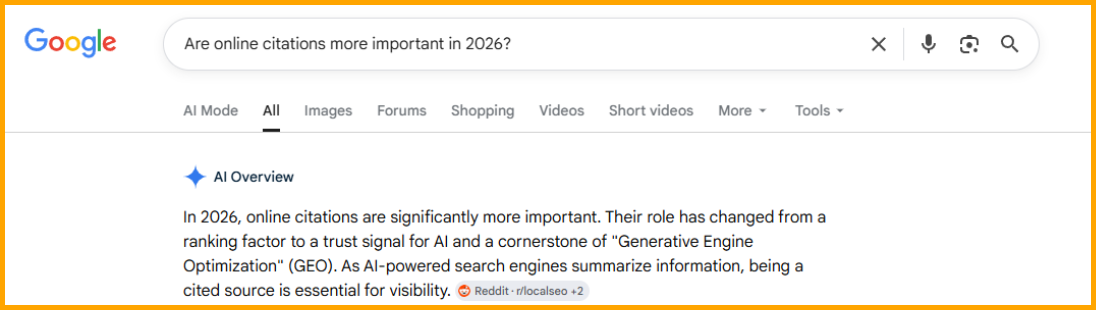
Modern search results can include AI Overviews, map packs, review snippets, featured snippets, People Also Ask boxes, videos, forums, social posts, and product results. A customer searching for “best emergency plumber near me” might see star ratings, business hours, service areas, recent reviews, pricing information, common questions, and AI-generated summaries before opening a single website.
This is called zero-click behavior. It means people can gather enough information from the search results page to take their next step without visiting a website first.
This doesn’t mean your website is useless. Far from it. Your website is still your home base. It explains your services, builds trust, supports your local SEO, and helps turn interested visitors into leads.
However, your website is no longer the only place where customers form opinions.
Google’s own documentation says AI Overviews and AI Mode may use a query fan-out technique, where Google issues multiple related searches across subtopics and data sources to generate responses and display helpful links. In plain English, that means AI-powered search experiences may look across several sources to build an answer, not just one page from one website.
For small businesses, that creates a clear takeaway: your information needs to be easy to find, easy to understand, and consistent across the web. Your website still matters, but your business also needs to be clear enough and credible enough to appear in maps, reviews, directories, social posts, AI answers, and other search features.
AI Search Tools Need Sources They Can Trust
AI search tools like ChatGPT, Claude, and Google AI Overviews don’t magically know which business is best; they summarize information from available sources. That information may come from websites, directories, reviews, articles, business profiles, videos, forums, and other online content.
This is where small businesses need to be careful. No one can honestly promise that one blog post, one schema update, or one directory listing will guarantee an AI citation. Search engines and AI tools decide what to show based on many factors, and those systems change over time.
Still, businesses can improve their chances of being understood.
AI search tools tend to work better with information that is clear, organized, specific, and trustworthy. A vague service page that says “we offer quality work at great prices” doesn’t give search systems much to work with. A detailed page explaining services, locations, processes, timelines, common questions, and real customer concerns gives those systems far more context.
For example, a roofing company could publish a basic blog called “Why Roof Maintenance Matters.” That might be fine, but it is not especially useful or unique. A stronger article might answer, “How Often Should Homeowners Schedule Roof Inspections in Storm-Prone Areas?” That type of content gives clearer information, answers a real question, and has a better chance of being summarized, cited, or linked.
Local Search Still Relies on Prominence
Local search isn’t only about who has the nicest website. Google says local results are based mainly on relevance, distance, and prominence. Relevance means how well your business matches the search. Distance means how close your business is to the searcher or searched location. Prominence refers to how well-known or well-regarded a business appears to be, based on information Google finds across the web. Google specifically notes that links, articles, directories, and reviews can all factor into prominence.
That last part is where citations become especially important. When you tell Google what you do, it listens, but when other trusted places online help confirm the details, it listens even more.
A plumber mentioned in local home service guides sends a different trust signal than a plumber with no mentions anywhere. A restaurant with steady, detailed reviews gives customers more confidence than one with sparse feedback. A contractor listed consistently across industry directories is easier to verify. A law firm quoted in local media can build authority.
Reviews Have Become Discovery Platforms
Reviews have become a lot more than reputation management tools.
Many of today’s customers compare ratings, read recent experiences, look for photos, scan complaints, and check whether a business responds professionally. For local services, restaurants, healthcare providers, home improvement companies, and professional services, reviews often influence decisions before customers visit a website.
A strong review profile helps answer the questions that customers may not ask out loud:
- • Can this company be trusted?
- • Do they show up on time?
- • Do they communicate well?
- • Are customers happy with the results?
- • Do they handle problems professionally?
- • Have they done this kind of work before?
Specific reviews are especially valuable. “Great service” is nice. “They repaired our leaking roof after a windstorm and explained the whole insurance process” is much more useful. That second review tells future customers what the business does, when someone might need them, and why their service matters.
Social Content Now Helps Customers Validate Businesses
Social media is no longer just a place to post holiday hours and the occasional promotion. Customers use social platforms to research, compare, and validate businesses.
Someone might find a restaurant through an Instagram search. A homeowner might check Facebook for before-and-after photos from a remodeler. A business owner might look at LinkedIn to evaluate a consultant.
This doesn’t mean every small business needs to go viral. In fact, viral content is usually not the point. Most local businesses don’t need millions of views. They need the right people to see enough proof to feel comfortable reaching out.
A helpful social presence can show:
- • Real completed work
- • Customer questions and answers
- • Behind-the-scenes expertise
- • Team personality
- • Service explanations
- • Community involvement
- • Recent activity
- • Reviews and testimonials
- • Photos and videos that prove the business is legitimate
For small businesses, social content acts like a trust trail. It gives customers more places to see that you are active, knowledgeable, and real. When that content gets shared, mentioned, recommended, or discussed, it becomes another type of citation—one that can influence decisions before a website visit ever happens.
What Makes Content “Citation-Worthy”?
Not every blog, service page, or social post is equally likely to get cited. Some content gets ignored because it is too vague, too thin, too promotional, or too hard to understand. Citation-worthy content does something more useful: it gives people, search engines, and AI tools clear information worth referencing.
It’s Specific
Vague content is easy to skim and easy to forget. Specific content is easier to trust, quote, and use.
For example, this sentence is too broad: “Roofs last a long time.”
That may be true, but it doesn’t help a homeowner make a decision. It gives no timeline, no context, and no explanation.
A stronger version would be: “Most asphalt shingle roofs last 20 to 30 years, but severe weather, ventilation issues, and poor installation can shorten that timeline.”
That version gives readers useful context. It explains what type of roof is being discussed, provides a general lifespan, and mentions factors that can affect the outcome.
Specificity makes content more helpful because customers are usually not looking for generic reassurance. They want to know what applies to their situation. A homeowner with missing shingles, a restaurant owner comparing grease trap cleaning schedules, or a retailer choosing new flooring needs practical information they can act on.
It’s Useful
Citation-worthy content is designed to help someone make a better decision.
A basic blog might explain what a service is. A stronger blog explains when someone needs that service, what warning signs to watch for, what mistakes to avoid, what questions to ask, and what next steps make sense.
For example, a blog about water heater repair shouldn’t just say, “A water heater heats water for your home.” Most readers already know that. More useful content would explain:
- • Why hot water may run out too quickly
- • When strange noises could signal sediment buildup
- • How leaks can point to different problems
- • When repair may make sense
- • When replacement may be safer or more cost-effective
- • What homeowners should check before calling a professional
That kind of content earns attention because it helps customers move from confusion to confidence.
Useful content also creates better sales conversations. When customers already understand the basics, they can ask smarter questions, recognize your expertise faster, and feel more prepared to take action.
It’s Trustworthy
Platforms are more likely to cite content that feels reliable. Search engines and AI tools also need clear signals that information is accurate, current, and credible.
Trustworthy content usually includes a mix of several elements:
- • Authoritative sources that support important claims
- • Real expertise from business owners, technicians, specialists, or experienced team members
- • Clear explanations that show why something matters
- • Up-to-date information that reflects current standards, prices, expectations, or best practices
- • Transparent limitations when an answer depends on location, materials, condition, budget, or other factors
- • Practical recommendations that help readers take the next step
For small businesses, trust doesn’t require sounding like a textbook. In fact, overly stiff content can feel less helpful. A trustworthy article should sound like a knowledgeable professional explaining something clearly to a customer.
For example, instead of saying, “All HVAC systems should be replaced after 15 years,” a more trustworthy version would say, “Many HVAC systems last 15 to 20 years, but maintenance history, usage, installation quality, and local climate can all affect whether repair or replacement makes more sense.”
That second answer is more useful because it is honest. It gives a general range without pretending every situation is identical.
That kind of accuracy matters. Content becomes easier to cite when it gives readers confidence without exaggerating.

It’s Easy To Quote or Summarize
Even strong information can get overlooked if it’s buried in messy formatting. Citation-worthy content should be easy to scan, quote, summarize, and repurpose.
Use clear headings so readers know what each section covers. Add short definitions when introducing important terms. Put direct answers near the top of sections. Use lists when steps, signs, benefits, or mistakes need to be easy to scan. Add tables when comparing options. Include FAQs when customers regularly ask the same questions.
Strong organization helps everyone:
- • Readers can find answers faster
- • Search engines can better understand the page
- • AI tools can more easily identify key information
- • Other websites can quote or link to specific points
- • Your own team can repurpose content for social posts, emails, and sales materials.
For example, a blog section titled “When Should You Replace Your Water Heater?” is easier to reference than a vague section called “More Information.” A table comparing “Repair vs. Replacement” is easier to summarize than five dense paragraphs. A short FAQ answer can be pulled into search features more easily than a buried answer hidden halfway down the page.
If you want more citations, make your content easier to use.
Being Cited Starts With Being Clear, Helpful, and Easy To Find
Getting cited in 2026 is all about making your business easier to understand, easier to verify, and easier to trust wherever customers look for answers.
LinkNow is also helping businesses prepare for this shift at a deeper level. Through our partnership with Next Net, we’re helping our small business clients organize their website content into a smarter reference system, making it easier for AI crawlers to quickly find the most relevant parts of their site when answering customer questions.
Ready to make your business more visible in search, maps, social platforms, and AI-powered answers? Contact LinkNow today to learn how our digital marketing services can help you get found—and chosen.