

Overview
This blog explores why trustworthy content matters more than ever in 2026 and argues that topical authority has become one of the strongest ways to earn credibility with both readers and search engines.
Highlights
- • Why Trustworthy Content Matters More Than Ever
- • What Does “Topical Authority” Actually Mean?
- • What Contributes To Topical Authority?
- • Common Mistakes That Destroy Trust
Introduction
Two businesses can answer the same question online and get completely different results. One earns a quick glance and a bounce. The other earns attention, confidence, and eventually a call, click, or sale. The difference isn’t always better design, bigger budgets, or even better writing. More often, it comes down to trust.
That idea has become especially important in 2026, when publishing content is easier than ever but earning trust is much harder. Small business websites are no longer competing just to be seen. Readers want signs that a business knows its subject, understands their concerns, and can offer information that feels grounded rather than recycled.
This is where topical authority becomes such a powerful advantage. When a business consistently publishes useful, accurate content around a clear niche, it starts to build credibility. Over time, that credibility can shape how users view the brand, how search engines interpret the site, and how effectively content supports every stage of the customer journey.

Why Trustworthy Content Matters More Than Ever
Publishing online used to feel a bit like entering a talent show. Put something useful on a page, give it a decent headline, and hope the crowd notices. In 2026, it feels more like trying to be heard in a stadium where everyone has a microphone. The internet is packed with fast, low-effort content, much of it written to fill space rather than answer real questions. That makes trust more valuable than ever.
Search Engines Have Gotten Smarter
Search engines have responded to this breadth of content by getting pickier about what deserves visibility. Google’s guidance continues to stress helpful, reliable, people-first content, not pages created just to gain rankings. It also continues to point site owners toward E-E-A-T (experience, expertise, authoritativeness, and trust) as an important way of thinking about content quality.
In plain English, strong content should feel useful, believable, and connected to real knowledge rather than generic copy produced at scale.
And So Have Users
Readers have changed too. Consumers have got a lot better at spotting fluff. When a page feels vague or unproven, people leave fast because they don’t want a wall of empty advice. They want clear answers, practical insight, and signs that the business behind the content actually knows its subject.
Reader trust can influence a wide range of outcomes, including:
- • Whether someone clicks on your site
- • How long they stay on the page
- • Whether they contact your business
- • Whether another website links to you
- • How your brand is remembered after that first visit
The Good News? Your Business Can Reliably Build Trust
For small business owners, this should feel encouraging, not intimidating.
A local company doesn’t need to out-publish giant brands to earn trust. Nor does it need 1,000 blog posts, a newsroom, or a corporate-sized content team. What it does need is a believable voice and a consistent track record in its niche.
For example, a roofing contractor that regularly publishes honest, useful guidance about leaks, storm damage, inspections, and replacement options can become far more trustworthy than a larger site posting random, watered-down articles on every home topic under the sun.
What Does “Topical Authority” Actually Mean?
Topical authority sounds like one of those marketing phrases that escaped from a boardroom and now wants its own LinkedIn account. In plain English, though, the idea is pretty simple. Topical authority is the trust a website earns when it covers a subject thoroughly and accurately over time. Instead of publishing one decent page and calling it a day, a business builds authority by becoming a dependable source for the bigger conversation around that subject.
Put simply, topical authority grows when a business becomes known for answering the kinds of questions people actually have about a specific subject. A company that repeatedly publishes useful, well-organized content within its niche starts to look less like a random voice online and more like a dependable resource.

Topical Authority Is All About Trust
Think of topical authority like choosing between two people for car advice. One is the trusted neighborhood mechanic who has worked on engines for years, answered hundreds of customer questions, and can explain problems in a way that makes sense. The other is someone who read one blog about engines yesterday and suddenly wants to sound like an expert.
Most people know which source feels more believable.
Websites work the same way. When a business consistently publishes thoughtful, accurate content around one subject area, it starts to resemble that trusted mechanic. It becomes the source people return to because the information feels reliable. That is what topical authority really is: proving over time that your business is worth listening to.
What Contributes To Topical Authority?
Topical authority doesn’t come from publishing more just for the sake of publishing more. It grows when a business creates a clear, helpful body of content that shows real knowledge and stays focused on the subjects that matter most to its audience.
Think of this section as a practical checklist. When more of these pieces are in place, authority becomes much easier to build for your small business.
Consistent Topic Coverage
A trustworthy website keeps showing up with useful content on closely related subjects. That consistency helps readers see that the business knows its niche, and it helps search engines understand what the site is really about.
For example, a business that wants to build authority around payroll services shouldn’t stop after one article on payroll mistakes. It should also cover things like payroll compliance, employee classification, tax deadlines, direct deposit questions, payroll software concerns, and common issues small businesses face throughout the year.
Breadth Plus Depth
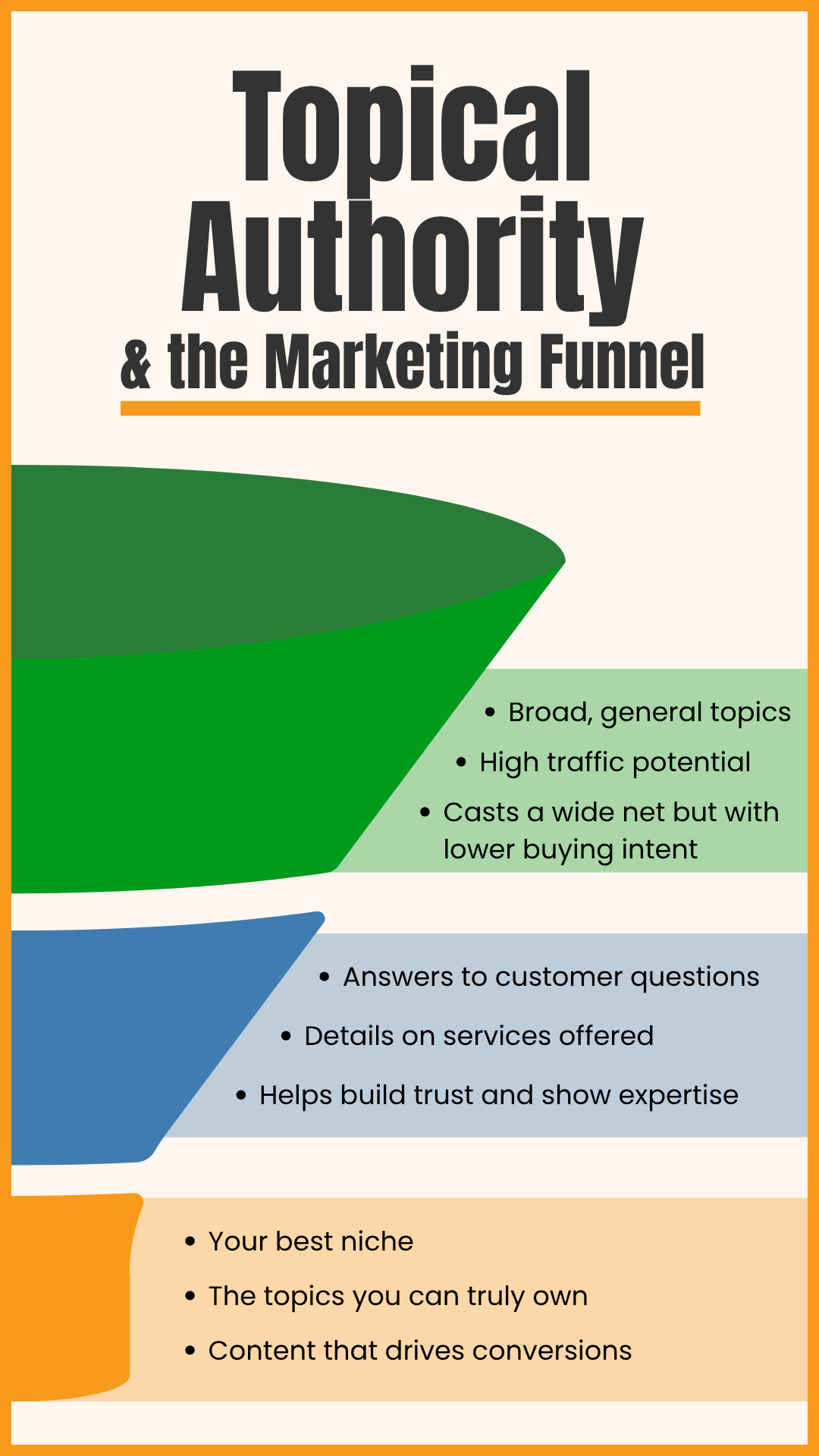
Authority needs range, but it also needs detail. A strong content strategy covers both broad searches and highly specific ones. It should help beginners who are just learning and also support people who are further along and need more advanced answers.
That means a business should create content for simple, top-level questions as well as more detailed follow-up topics. One page might explain the basics of commercial roof repair, while another tackles how seasonal weather affects roofing materials, and another compares repair versus replacement costs.
Broad content brings people in. Deeper content proves the business actually understands the subject.
Strong Internal Linking
Topical authority becomes much easier to recognize when related pages connect logically. Internal links show readers where to go next, and they help search engines understand that multiple pages belong to the same subject area.
A good internal linking structure feels natural. A beginner’s guide could lead to supporting articles. A service page can connect to FAQs. A blog about warning signs could link to a page explaining repair options. These connections turn separate pages into a real content ecosystem instead of a pile of disconnected posts.
Original Insights and Examples
Generic advice rarely builds trust. Authority grows faster when content includes real examples, experience-based observations, useful opinions, and explanations rooted in actual work. That kind of detail gives a page more weight because it sounds like it came from someone who has seen the issue firsthand.
This can show up in many ways. A contractor might explain the most common surprise found during an inspection. A tax professional might highlight mistakes small businesses repeat every filing season. A marketing agency might share what usually causes a local SEO strategy to stall.
Freshness Where It Matters
Not every page needs constant updating, but some topics do. Content should stay current when facts, regulations, tools, industry standards, or best practices change. Outdated advice can weaken trust quickly, especially when readers are making decisions based on the information they find.
Regular updates also send an important message beyond accuracy. They show that a business is staying up to date with changes in its field. When readers land on a page that feels current and well-
maintained, they are more likely to trust the
information and the company behind it.
Off-Site Validation
A business doesn’t build authority only by talking about itself. Outside recognition matters too. When other credible sources mention, cite, link to, review, or feature a business, that adds another layer of trust.
This can come from backlinks, local news features, guest articles, professional associations, certifications, awards, and strong review signals. These outside references help support the idea that the business is respected beyond its own website.
Structured Content Architecture
Even excellent content can lose impact when it’s poorly organized. A strong structure makes authority easier to build because it shows how the main topic and supporting subjects fit together.
This often looks like topic clusters built around a core subject. A main pillar page can introduce the broader topic, while supporting blogs answer related questions in more detail. Service pages, FAQ sections, and resource hubs can all play a role. Good architecture helps users move through the site with less friction, and it makes the full scope of your expertise easier to see.
Common Mistakes That Destroy Trust
Just like in the real world, online trust takes time to build and very little time to lose. A business can publish often, target the right keywords, and still struggle if the content feels unreliable or misleading.
Google’s guidance continues to push back against deceptive tactics, low-value pages, scaled content abuse, and invalid structured data, which means trust-killing mistakes can hurt user confidence and search visibility equally.
Some of the most common mistakes include:
- • Publishing outside your actual expertise
- • Chasing every keyword trend
- • Relying too heavily on AI without adding original value
- • Making claims without evidence
- • Hiding who is behind the website
- • Letting old pages become outdated
- • Creating multiple pages that all say the same thing
- • Ignoring user intent and experience
In most cases, these mistakes have one thing in common: they put search engines first and people second. That approach is exactly what makes content feel untrustworthy in 2026.
Trust Comes From Depth, Not Noise
Trustworthy content isn’t just a nice addition to a marketing strategy. It is one of the clearest signals that your business deserves attention. Readers want answers they can believe, and search engines want to recommend sources that appear genuinely helpful. That makes topical authority one of the most practical ways for small businesses to stand out online.
Fortunately, building trust doesn’t require publishing the most content. It requires publishing the right content with consistency, focus, and real value. If you need help covering your niche and establishing topical authority, LinkNow is here to help. Get in touch with our team today to discuss how we can create custom content tailored to your unique business.