

Overview
We’re strong believers in data. And when it comes to blogging, the data keeps telling us the same story: the businesses that blog consistently are pulling ahead. This blog breaks down what actually stood out when we compared our blogging clients to the ones who don’t.
Highlights
- • What We Actually Compared
- • Blogging Clients See Stronger Lead and Traffic Growth
- • Blogging Clients Earn More Organic Backlinks
- • Blogging Clients Show Up More in AI Answers and Featured Snippets
- • Real Example: A Texas Landscaping Business
Introduction
Working with over 10,000 small businesses across North America gives us a pretty rare vantage point. We get to see, across industries and markets, what actually moves the needle for local businesses trying to grow (and what doesn’t).
So we decided to dig into a question we hear all the time: Is blogging still worth it in 2026, or is it outdated advice left over from a different era of SEO? With AI search tools reshaping how people find information, it’s a fair thing to wonder.
To find out, we looked at the trends separating our clients who blog consistently from those who don’t. In this blog, we’re covering everything from lead growth and backlinks to visibility in AI-generated answers. We’ll also walk through a real client example that shows what this can look like in practice.
What We Actually Compared
Before we get into the good stuff, let’s talk about how we approached our research.
Across our client base, we looked at two groups: businesses that published blog content regularly (think at least monthly, over a sustained stretch of time) and businesses that either never blogged or did it so sporadically it barely counted. We then looked at how their marketing performance changed over time: traffic, leads, keyword visibility, backlinks, and how often they appeared in places like Featured Snippets and AI-generated answers.
What we’re sharing here are trends. The patterns that recurred across a large, diverse group of small businesses. Our goal is to uncover what tends to happen when a small business commits to consistent blogging versus when it doesn’t.
Trend #1: Blogging Clients See Stronger Lead and Traffic Growth
Let’s start with the trend that surprised absolutely no one on our team, but still deserves the spotlight: businesses that blog consistently generate more leads and more organic traffic than those that don’t.
Here’s a simplified look at what we tend to see across the board:
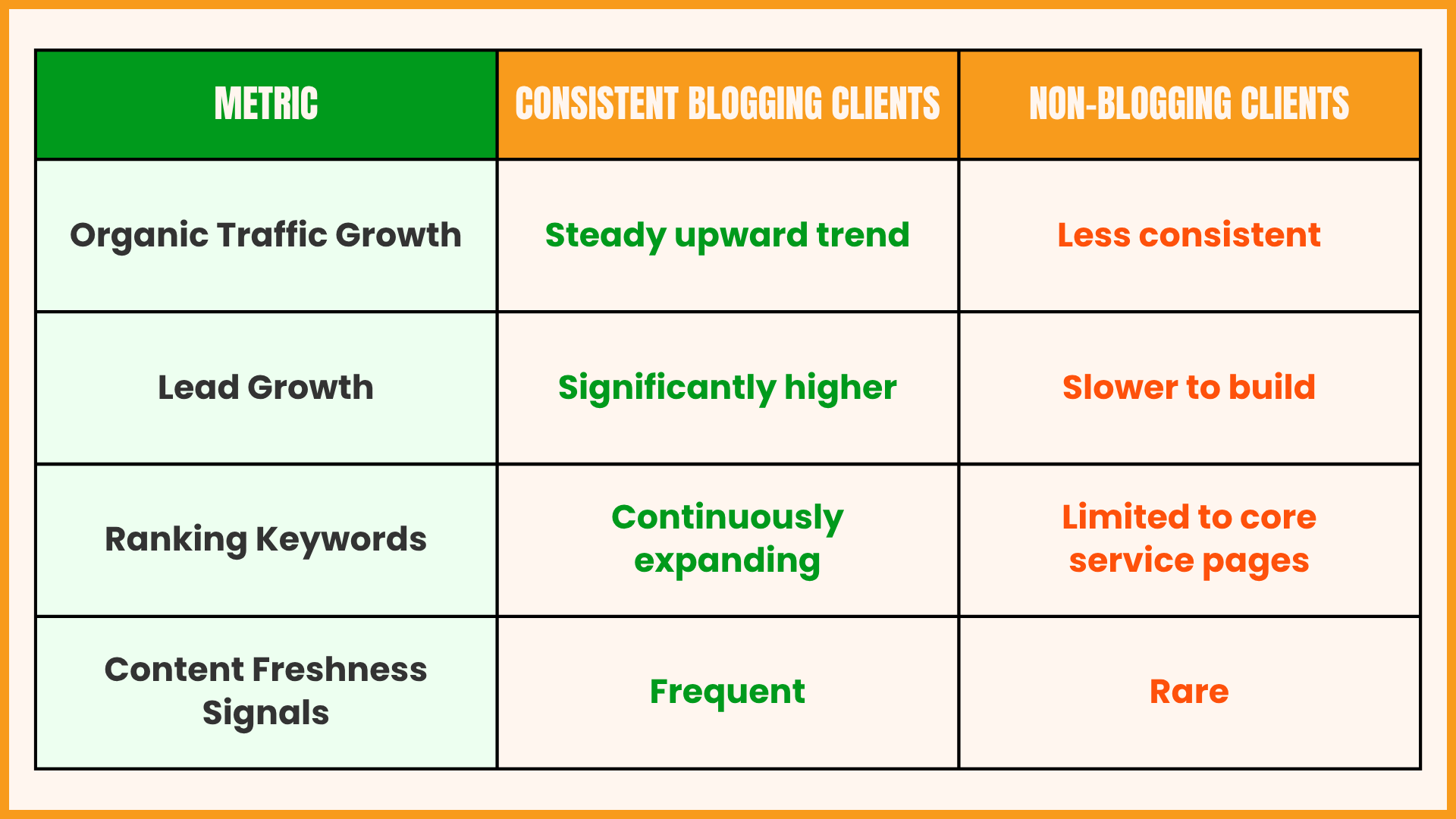
This tracks with what’s happening industry-wide. According to HubSpot’s 2026 State of Marketing Report, small businesses are 23% more likely than average to see a return on investment from their blog posts. And according to DemandSage’s Business Blogging Statistics of 2026, businesses that blog see 126% more lead growth than those that don’t.
The Logic Behind This Trend
So why does this keep happening? The explanation is simple once you break it down. Every blog post is a new page on your website, and every new page is another opportunity for Google (and now, AI search tools) to find you.
If your website is only five pages (home, about, services, contact, maybe a gallery), you’re only giving search engines five chances to match you with someone’s search. But if you’re publishing a new blog post every month that answers real customer questions, you’re steadily building a bigger footprint of pages that can rank for the exact things your customers are typing into Google.
More indexed pages generally mean more keyword opportunities, and more keyword opportunities mean more chances for the right person to find you at the right moment.
Trend #2: Blogging Clients Earn More Organic Backlinks
If the last trend was about visibility, this next one is about credibility. This is where blogging really starts to pay off in ways a lot of small business owners don’t expect.
Backlinks, if you’re not familiar, are basically the internet’s version of a word-of-mouth referral. When another website links to yours, it’s essentially telling Google, “Hey, this business knows what they’re talking about.” And Google takes that seriously. The more quality sites vouching for you, the more trustworthy and authoritative your website looks in search results, which can help you outrank competitors.
So here’s the trend we noticed: blogging clients consistently earned more backlinks over time than clients without a blog. It makes sense when you think about it — another industry outlet isn’t going to link to your homepage. But they might link to a blog post you wrote that breaks down “what to know before your first HVAC tune-up.” Industry directories, local partners, and even other bloggers are far more likely to reference a genuinely helpful article than a service page.
What To Know About Earning Backlinks
We want to be clear about one thing, though: this isn’t an overnight win. Backlinks build gradually, almost like a reputation does. One blog post might get picked up quickly; another might sit quietly for months before a publication stumbles on it. But clients who stuck with a consistent blogging cadence saw their backlink profiles grow steadily over time. In turn, this reinforced their overall domain authority and made every page on their site, blog or otherwise, a little more likely to rank well.
Trend #3: Blogging Clients Show Up More in AI Answers and Featured Snippets

Here’s the trend that’s becoming impossible to ignore in 2026: it’s not just about ranking on Google anymore. Getting picked up by the AI tools your customers are increasingly using is becoming a key way to get found online. Think things like Google’s AI Overviews, ChatGPT, Perplexity, and similar answer engines that summarize information instead of just listing links.
And what we’ve noticed is this: blogging clients show up in these AI-generated answers far more often than clients without a blog. Once you understand how these tools work, it makes a lot of sense why.
AI answer engines are built to do one thing really well, namely, find clear, well-structured content that directly answers a question, then summarize it. A homepage that says “Family-owned remodeling company serving the greater Montreal area since 2005” doesn't give an AI tool much to work with. But a blog post titled “How Long Does a Kitchen Remodel Usually Take?” that clearly answers the question in the first few sentences? That’s exactly the kind of content these tools are designed to pull from and cite.
Blog Formatting Matters for AI Crawlers
The way that you display the content of your blog also plays an important role in making things easier for both readers and search tools to understand. Clear titles, descriptive headings, short paragraphs, numbered steps, and bullet lists help organize information into sections that can be scanned and summarized quickly.
This is also why FAQ-style content performs exceptionally well across AI platforms. Blog posts that anticipate real customer questions (and answer them clearly and directly) are naturally suited for Google’s Featured Snippets, People Also Ask sections, and AI Overviews. It’s essentially the same skill in two different formats: answer the question people are actually asking, as clearly as possible.
Real Example: A Texas Landscaping Business
Sometimes the numbers make more sense with a real story attached, so let’s take a look at one of the small businesses we helped.
A landscaping business in Texas came to us a few years ago with a solid reputation and loyal customer base, but zero blog content on their website. Their site had the basics (services, photos, contact info), but nothing that answered the everyday questions their customers were already searching for online.
We started them on a consistent monthly blogging cadence, focused on two things: seasonal tips (like when to aerate, water, or reseed a lawn in Texas heat) and the common questions their own customer service team fielded on repeat. Our focus was on providing genuinely useful, locally relevant content, published consistently.
Over the next 12 months, we saw:
- • Organic traffic up 34%. This represents a steady, realistic climb, not a sudden spike
- • More monthly leads, calls, and booking requests attributed directly to organic search
- • Appearances in Google’s AI Overviews for seasonal topics
What’s worth noting here is why this worked. It wasn’t about publishing constantly or chasing viral topics. It was about showing up consistently and actually answering the questions their customers were already asking. Over time, this built exactly the kind of visibility and trust we’ve been talking about in the trends above.
Find Out What Consistent Blogging Could Do for Your Business
Blogging works best when it’s guided by a clear strategy, real customer questions, and consistent execution. At LinkNow, our approach is backed by insights gathered from more than 10,000 small business clients across a wide range of industries.
Connect with us today for a content strategy consultation to learn how building a blog pipeline can strengthen your organic visibility and support long-term growth.