
Overview
This blog breaks down Google’s official guide to optimizing for generative AI features in Search. We explain what Google actually recommends, what small business owners can ignore, and how strong SEO fundamentals still support visibility in AI-powered results.
Highlights
- • What Is Google’s New AI Optimization Guide?
- • How Google Uses SEO To Populate AI Answers
- • What Google Wants: Valuable, Non-Commodity Content
- • Images and Visual Content Matter in AI Search Too
- • Technical SEO Matters More Than Ever
- • What You Don’t Need To Do for AI Search
Introduction
Google finally said the quiet part out loud: businesses don’t need to throw out their SEO strategies and start over.
With its new AI optimization guide, Google has published official best practices for appearing in generative AI features on Search, including AI Overviews and AI Mode. For small business owners, this is welcome news. After months of buzz around AI search, AEO, GEO, and every other new acronym under the sun, Google’s advice is refreshingly familiar.
The main message? Strong SEO still matters.
In this blog, we’re taking a closer look at this new guide to help small business owners understand what matters (and what doesn’t) going forward.
What Is Google’s New AI Optimization Guide?
Google’s new AI optimization guide is written for website owners who want to understand how their content can appear in generative AI features on Google Search. Google is essentially giving businesses a clearer look at how to show up when Search uses AI to summarize answers, recommend resources, and point users toward helpful websites.
The guide focuses on features like AI Overviews and AI Mode, which are designed to help searchers explore questions in a more conversational way. Instead of only showing a traditional list of blue links, these features can generate a more complete answer and include links to relevant websites that support that response.
The Big Takeaway: AI SEO Is Still SEO
If you read one thing from Google’s new guide and immediately close the tab, make it this: SEO is still relevant.
That may sound obvious, but it is an important point for business owners. Whenever a new technology enters the marketing world, people rush to announce that everything has changed. Search is dead. Keywords are dead. Websites are dead. Your homepage must now be written for robots.
Thankfully, Google’s actual guidance is much more grounded.
According to Google, generative AI features on Search are rooted in its core Search ranking and quality systems. In other words, Google has not created a completely separate universe where regular SEO no longer matters. AI Overviews and AI Mode still depend on Google’s ability to find useful web pages, understand what those pages say, and decide which sources are relevant enough to support an answer.
Why This Guide Matters for Small Businesses
For small business owners, Google is saying that SEO fundamentals still deserve attention. Helpful content matters. Crawlability matters. Indexability matters. Page experience matters. Strong site structure matters. Authority and trust matter. Clear business, service, and product information matter.
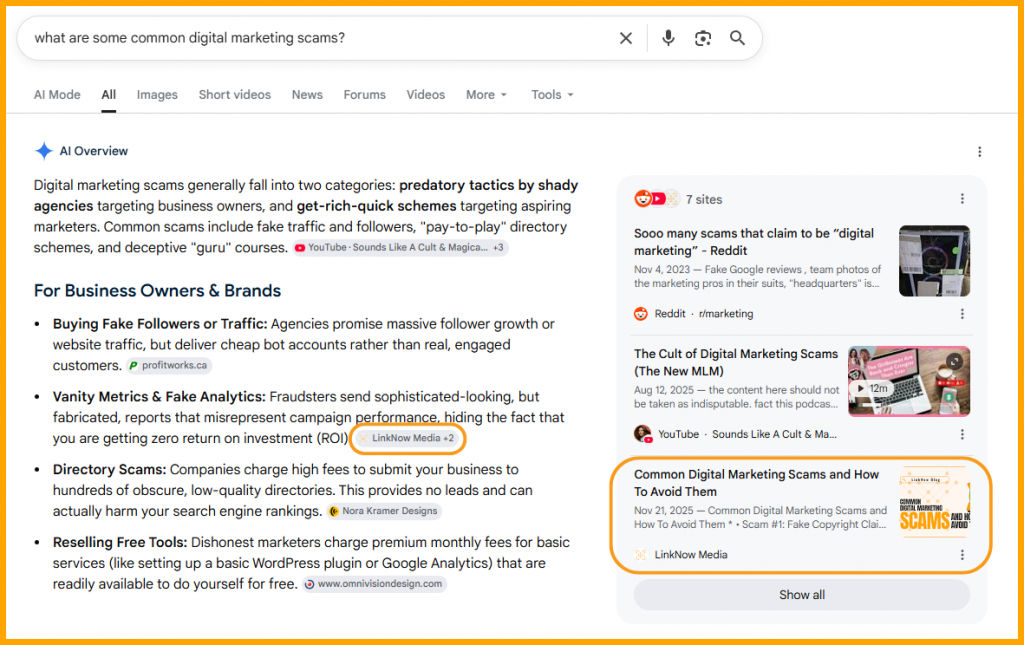
By following SEO fundamentals and creating people-first content, we've been able to improve our blog traffic with AI Overviews
A local plumber, accountant, landscaper, roofer, or retailer doesn’t need to throw out their SEO strategy and start speaking fluent machine learning. They need to make sure their website answers real customer questions, explains their services clearly, loads properly, works well on mobile devices, and gives Google enough accessible information to understand what the business offers.
That may not sound as flashy as a brand-new AI hack, but that’s exactly the point. Google’s guide makes AI visibility feel less like a mystery and more like the next stage of solid SEO. Businesses that already invest in useful content, technically sound websites, and trustworthy online information are building on the same foundation Google has been recommending for years.
How Google Uses SEO To Populate AI Answers
When someone searches with AI Overviews or AI Mode, Google isn’t starting from a blank page. Its systems can use the existing Search index to find relevant web pages, pull together useful context, and support AI-generated responses with links to source material.
Two ideas from Google’s guide are especially helpful here: retrieval-augmented generation and query fan-out. They sound technical, but both point to familiar SEO lessons.
Retrieval-Augmented Generation: Google Checks Its Notes First
Google’s guide mentions something called retrieval-augmented generation, also called RAG. Thankfully, business owners don’t need to memorize that phrase or explain it at networking events.
Put simply, RAG is when Google checks Search rankings before providing AI answers.

Think of it like asking an assistant a question. A less helpful assistant might answer from memory and hope for the best. A better assistant would check reliable notes, pull out relevant information, compare useful sources, and then give you an answer based on what they found.
That is the basic idea behind retrieval-augmented generation. Google uses its core Search ranking systems to retrieve relevant, up-to-date web pages from its Search index. Then, its systems use information from those pages to generate a more helpful AI response with clickable links that support the answer.
Query Fan-Out: Using More Than One Search at a Time
Google’s guide also talks about something called query fan-out. Again, the phrase sounds technical, but the concept is simple.
When someone asks Google a detailed question, Google may look at that question from several angles at once. Instead of relying on one search, its systems may generate multiple related searches to gather more complete information.

For example, Google says a question like “how to fix a lawn that’s full of weeds” could lead to related searches about the best herbicides for lawns, removing weeds without chemicals, and preventing weeds from coming back.
That’s query fan-out. Google isn’t just matching one exact phrase. It is exploring related ideas that may help answer the searcher’s real question.
For small business websites, this creates an important lesson: your content should be helpful enough to support related customer questions without becoming repetitive or spammy.
What Google Wants: Valuable, Non-Commodity Content
Google’s biggest content recommendation might also be the most important takeaway for small business owners: stop publishing content that could have come from anyone.
In the AI SEO guide, Google says unique, compelling, useful content will likely influence a website’s presence in generative AI search more than anything else in the guide over the long run. That’s a big statement. It means businesses should focus less on chasing shiny AI tricks and more on creating content that actually gives customers something worthwhile.
Google calls this non-commodity content.
What Is Non-Commodity Content?
Commodity content is generic content, whereas non-commodity content brings something original to the table.
Non-commodity content goes beyond common knowledge by including things such as:
- • Real experience
- • Expert insight
- • Specific examples
- • Original photos
- • Customer questions
- • Project details
- • Case studies
- • A clear point of view
Commodity content says: “Here are 7 tips for maintaining your HVAC system.”
Stronger non-commodity content says: “Here’s what our technicians see most often in 15-year-old HVAC systems in humid climates—and what homeowners can do before repair costs spike.”
See the difference? One version gives standard advice. The other shows experience. It tells readers that the business has seen real problems, helped real customers, and learned something useful along the way.
That’s the kind of content small businesses are uniquely positioned to create.
How Small Businesses Can Create Better Non-Commodity Content
The easiest way to create content that boosts your performance across search platforms is to understand what makes your business different. The good news is that this doesn’t need to be complicated. It can be as simple as before-and-after photos from a project or a real customer question answered in detail.
Even if you outsource most of your content and marketing, a good web design company can write stronger service pages and blogs when it understands how your business actually works. The more details you provide, the easier it is to move beyond generic content and create something that reflects your knowledge, process, customers, and specializations.
Sharing these things can help your digital marketing company create better content:
- • Common customer questions
- • Services or problems they specialize in
- • Local challenges customers face
- • Project photos and before-and-after examples
- • Stories from recent jobs
- • Frequent misconceptions
- • Seasonal advice
- • Product or material preferences
- • Customer decision-making concerns
- • Details about your process, standards, and recommendations
Images and Visual Content Matter in AI Search Too
 When people think about SEO, they usually think about written content first. Service pages, blogs, FAQs, title tags, and keywords tend to get most of the attention. Those pieces still matter, but Google’s AI optimization guide makes another point worth noting: images and videos also play a role in generative AI search features.
Google says AI-powered search experiences can show relevant visuals, including images and videos. That gives businesses more ways to appear in front of potential customers beyond the traditional blue link.
For small businesses, this is a big opportunity. A helpful website photo gallery or social media content can often answer a customer’s question faster than a paragraph can.
Use Real Visuals Whenever Possible
Businesses don’t need Hollywood-level production to create useful visual content. In many cases, clear, honest, original visuals are better than overly polished ones.
A simple photo of a completed deck, a quick video explaining how a repair works, or a short project walkthrough can all add value. What matters most is that the visual helps customers understand something important.
For example:
- • A remodeler can build a before-and-after bathroom renovation gallery.
- • An auto repair shop can record a short video explaining signs of brake wear.
- • A restaurant can upload bright, accurate photos of popular menu items.
- • A contractor can create a project walkthrough video.
- • A landscaper can publish a seasonal maintenance guide with helpful visuals.
These examples work because they support customer decision-making. They show what the business knows, what it does, and what customers can expect.
Technical SEO Matters More Than Ever

Technical SEO may not sound exciting, but it remains one of the most important parts of getting your website seen, especially when it comes to AI-powered search. Before Google can use your content in Search or generative AI features, it needs to be able to find, access, process, and understand your pages.
This means your website needs a solid technical foundation. Great content won’t help much if important pages are hidden from Google, difficult to use on mobile devices, or buried in a confusing site structure.
Some of the most important technical milestones for any business website include:
- • Making sure important service pages, landing pages, blogs, and product pages are indexable
- • Checking Google Search Console regularly for indexing issues, crawl errors, and performance trends
- • Avoiding blocking important pages with robots.txt rules or noindex tags
- • Using descriptive title tags and meta descriptions that accurately explain each page
- • Fixing broken links, unnecessary redirect chains, and pages that lead users nowhere
- • Improving mobile experience so customers can easily read, click, call, and request service
- • Keeping pages stable and easy to use
- • Reducing duplicate or near-duplicate pages that don’t provide unique value
What You Don’t Need To Do for AI Search
Many AI SEO hacks sound futuristic, but Google’s advice is refreshingly boring: make useful content, keep your site accessible, and avoid spammy shortcuts. That may not sound as exciting as a secret AI formula, but it is good news for small business owners who have spent time and money investing in their SEO.
In its guide, Google lists several popular generative AI search tactics that businesses can ignore:
- • You don’t need an llms.txt file: Google says businesses do not need to create special AI text files, machine-readable files, new markup, or Markdown files to appear in generative AI search.
- • You don’t need to “chunk” content: Some advice suggests that businesses should break content into small pieces so AI systems can understand it better, but Google says that isn’t required. Its systems can understand multiple topics on a page and show the relevant part to users when appropriate.
- • You don’t need to rewrite everything for AI: Google says you don’t need to write in a special style just for generative AI search. It can understand synonyms, meaning, and different ways people describe the same topic.
- • You don’t need fake mentions: Google warns that chasing inauthentic mentions is not as helpful as it may seem. Real reputation-building matters more than artificial buzz.
- • You don’t need schema markup specially for AI: Structured data can still be useful as part of your broader SEO strategy because it can help your site become eligible for rich results. However, Google says there is no special schema markup businesses need to add just for AI visibility.
Chase Continuous Improvement, Not Trends
Google’s new AI SEO guide makes it clear that even though the future of search may look different, the goal is familiar: help users find the best answers and the best businesses.
AI search will keep evolving. Google’s results pages will continue changing. New tools, formats, and features will come and go. But businesses that focus on continuous improvement will be in a stronger position than those chasing short-lived tactics.
SEO isn’t dying anytime soon, and LinkNow is here to help. We’ve been helping thousands of small businesses navigate the challenges of web design and digital marketing for many years, and we continue to adapt with the industry.
Contact us today and let our team establish a solid online foundation for your business.