
Yes! I'd like to be contacted to schedule a consultation!
Everyone, at some point, will eventually need HVAC services. After all, heaters and air conditioners don’t last forever, and not having them working is a nightmare that nobody wants to sit through for long. When these issues hit, most people aren’t going to wait until they hear about an HVAC technician—instead, they’ll pull out their phones and find one online in seconds.
In this regard, as an HVAC company, growing your online presence is crucial. The industry’s immediacy and local nature mean you stand to gain a lot of business from optimizing your site for search engines. However, there’s a difference between wanting to grow your online presence and actually doing it.
LinkNow’s digital marketing team has compiled common mistakes that HVAC companies can make in their SEO efforts. We’ll go over content, mobile layout, local SEO, and image problems, as well as some ways you can fix them.
Your content makes up a significant part of your SEO efforts. Search engines will crawl and evaluate your content to see how likely it is to meet a user’s search intent. For a web crawler to judge your content highly, it needs to be high-quality—that is, it needs to be clear and free of errors. It also needs to be relevant to the topic it claims to be about and, ideally, comprehensive in its coverage.
Unfortunately, there’s no way around that formula other than sitting down and writing the content. However, there are some pitfalls to avoid to keep your content high-quality.
Common content mistakes HVAC technicians can make include the following:
Let’s start by explaining keywords. Keywords are the words a user would likely enter in a search. For example, the phrase “air conditioning repair in Miami” would likely be a search term if someone in Miami had issues with their AC unit.
From a content standpoint, a page’s keyword is essentially the same as its topic. You want a page’s main keyword to match what a user would search as closely as possible. Our “air conditioning repair in Miami” keyword would make a great topic—and title—for a page.
However, people sometimes make mistakes when they think that repeatedly mentioning a keyword will raise their page’s ranking in search engine results. This practice of repeatedly using a keyword is called keyword stuffing. It may have worked in the early days of the Internet, but it hasn’t been effective for many years. In fact, search engines actively try to punish keyword stuffing, identifying it as an attempt to cheat their algorithms.
In addition to the scam-like nature of keyword stuffing, it also creates some pretty poor content. An attempt at keyword stuffing might look like, “When you need air conditioning repair in Miami, our air conditioning repair in Miami experts have all the air conditioning repair in Miami solutions you need.”
Keyword stuffing reads poorly, doesn’t really say anything useful, and doesn’t provide much help for a user trying to get help with their HVAC system.
Rather than opting for keyword stuffing, consider using keyword clusters. A keyword cluster is a group of secondary (and even tertiary) keywords that follow from and expand on the primary keyword. A cluster of related keywords shows a web crawler that your page is providing detailed and comprehensive information on a given topic.
For “air conditioning repair in Miami,” web crawlers would want to see mentions of secondary keywords like “AC leak repair,” “ductless air conditioning repair,” or “AC not cooling.” Building a page with these additional keywords can improve its quality.
It’s like good ductwork: Your primary keyword is the main unit, and the secondary keywords lead the reader to the further information they need.
Keyword cannibalization is when you write two pages using the same keyword. It might seem like a worthwhile idea—you’ve got two chances to rank now—but there’s already enough competition on the Internet. With so many other pages you have to surpass, you don’t want your pages losing views to each other.
While it could be a deliberate strategy, keyword cannibalization is more often accidental for one of two reasons:
Avoiding keyword cannibalization comes down to thorough site and page planning. Awareness of what’s already on your site is critical to keeping your pages from competing with each other.
Page length is a major factor in Google’s rankings. More specifically, the longer a page is, the better its chances are of ranking highly. This does have diminishing returns, however. As soon as a page reaches about 2,000 words, it tends to make little difference if the word count increases.
This may seem slightly counterintuitive, as you might think someone in urgent need of HVAC services won’t want to read 2,000 words. Google, however, wants to make sure your page covers a topic comprehensively. If someone wants specific information, a 500 or even 300-word page is unlikely to cover a topic in enough depth to guarantee a user will find the answer to their search.
With some other SEO practices, you can prevent a user looking for a quick service from being put off by a lot of text. These practices include putting a call to action near the top of the page with a means of contacting you—think, “Call now to book air conditioner repair.”
Longer pages have the additional benefit of providing more detailed information on your services. A short page might not cover everything, while a longer page gives you more chances to provide useful information that a user might search for. You don’t want a potential customer to come to your “HVAC Services” page and be deterred because you didn’t mention your ability to install heat pumps.
If you’ve got high-quality pages that rank well, that’s fantastic! Unfortunately, you can’t stop there. You need to continue adding to or updating those pages. Updating pages could take the form of adding information, or you could replace content on the page. The former is an excellent way to build up the length of your pages over time.
Updating pages is important because if a page hasn’t been changed in a few years, a search engine could reasonably assume it no longer contains accurate information. Perhaps the service isn’t offered anymore, or, especially if the whole site hasn’t changed, perhaps the business isn’t around anymore. Either way, updating pages tells a search engine that your page is as accurate and relevant as ever.
As discussed earlier, when searching for a local HVAC technician, many people are likely to pull out their phones and look for one using a search engine. This situation makes it crucial that your site is set up to receive mobile visitors. A site that doesn’t load well on mobile devices leads to visitors quickly leaving, which costs your business and can even harm your search engine ranking.
The first step in optimizing your site for mobile devices is to have a separate mobile layout that adjusts well to different screen sizes, but there are other steps you can take.
Here are some tips for optimizing your site for mobile searches:
As an HVAC company, a lot of your business is local people who need your services in the near future. Search engines understand the importance of providing local businesses for people needing local services. After all, it doesn’t do anybody any good to show a Seattle-based company in a search for “emergency AC repair in Dallas.”
Local SEO refers to optimizing your website to rank well in searches with what’s called “local intent.” This could mean optimizing for searches within a specific location, such as “emergency AC repair in Dallas” or simply “emergency AC repair near me.” Some searches, especially those in the HVAC industry, might even be interpreted as having local intent without a location specifier, given the local nature of the field.
Let’s look at some of the ways you can optimize your site for local searches.
Of all the search engines, Google is the most frequently used, making it important that you appear on Google’s local search results. Google’s local search results usually appear on a map beside a list of local companies, such as in the picture below.
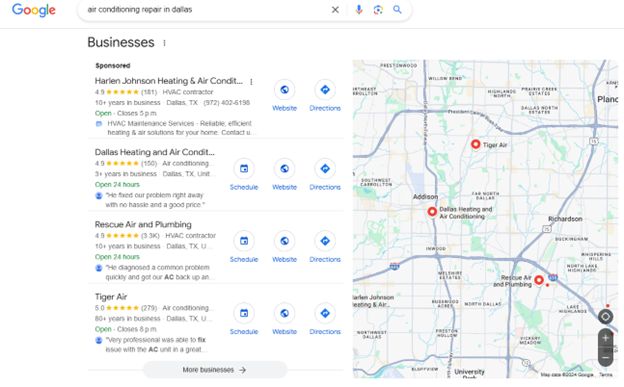
To appear in these local searches, you need to have a Google Business Profile (GBP). A GBP contains your business’ name, address, and phone number, among other information. It requires you to confirm your business with Google, essentially proving your information is accurate.
Other factors influence your local ranking, but having a GBP is a necessary first step. At LinkNow, it’s one of the first things we do for all our clients.
In addition to Google, you can add your business to several other local directories. Doing so provides proof of your business’ legitimacy to search engines and showcases your presence in your community.
The one thing to keep in mind is that the information needs to be consistent. If you have “Inc.” at the end of your name in one listing, it needs to be in all the others. If your address includes a unit number in one listing, it needs to be in the others.
Local keywords essentially just mean keywords that contain location-specific information. This means having pages on your site not just for “Heat Pump Installation” but for “Heat Pump Installation in Boston.”
These pages, called “landing pages,” are designed to help you rank in local searches. They don’t feature prominently on your site and are usually hidden under “Service Areas,” but they help bring local users to your site before they either call or go off to your main “Heat Pump Installation” page, which is considered a “service page.”
Photos can be a great way to showcase your work, but without care, they can do more harm than good.
We’ll look at three common image mistakes here, including:
A large image file risks slowing down your site’s loading time. Simply put, larger files take longer to load. Load time is a factor in SEO, though it’s more about reaching an acceptable level rather than being as fast as possible, so don’t shrink a file to a size where it becomes pixelated just to improve your load time.
Broken images occur when your site tries to display an image that no longer exists in its original location. When this happens, it naturally detracts from your site’s professionalism and the user experience. It also has negative consequences for your SEO.
When web crawlers index your site, they’ll only spend a certain amount of time before moving on. Broken images cause the web crawler to slow down as it waits in vain for the image to load. This added wait time means the web crawler won’t be able to index as many of your site’s pages. An unindexed page won’t be able to rank since the search engine won’t know what it contains. Identifying and fixing broken images allows the crawler to work quickly and index more of your pages.
Alt text is a short description of an image. It doesn’t appear on the page itself, but it’s in its code. You might be wondering: What’s the point?
Alt text serves two main functions:
When adding alt text to your images, it’s important to do a good job of ensuring it’s descriptive. Very general alt text is less helpful than specific information.
Say you have a picture of a ductless mini-split system in a living room. Using the alt text, “an air conditioner,” is far less helpful than “a ductless mini-split air conditioner in a living room.” The latter is especially good if you’ve recently been talking about ductless mini-splits on your page. Search engines want relevant, cohesive content.
One last thing to remember with alt text: Keep it concise—under 100 characters is usually a good limit. If it’s too long, screen readers can cut it off.
A strong online presence gives you a leg up in the HVAC industry’s immediate, local landscape. To get the most out of your online marketing, perfect your content strategy, create a user-friendly mobile layout, optimize for local SEO, and adhere to good image practices.
That can be easier said than done, however, as your HVAC work can keep you busy. If you need a helping hand with your digital marketing, contact the team at LinkNow. We have years of experience creating websites, content, and strategies to grow your online presence and attract new business.
Contact us now to book a free consultation.